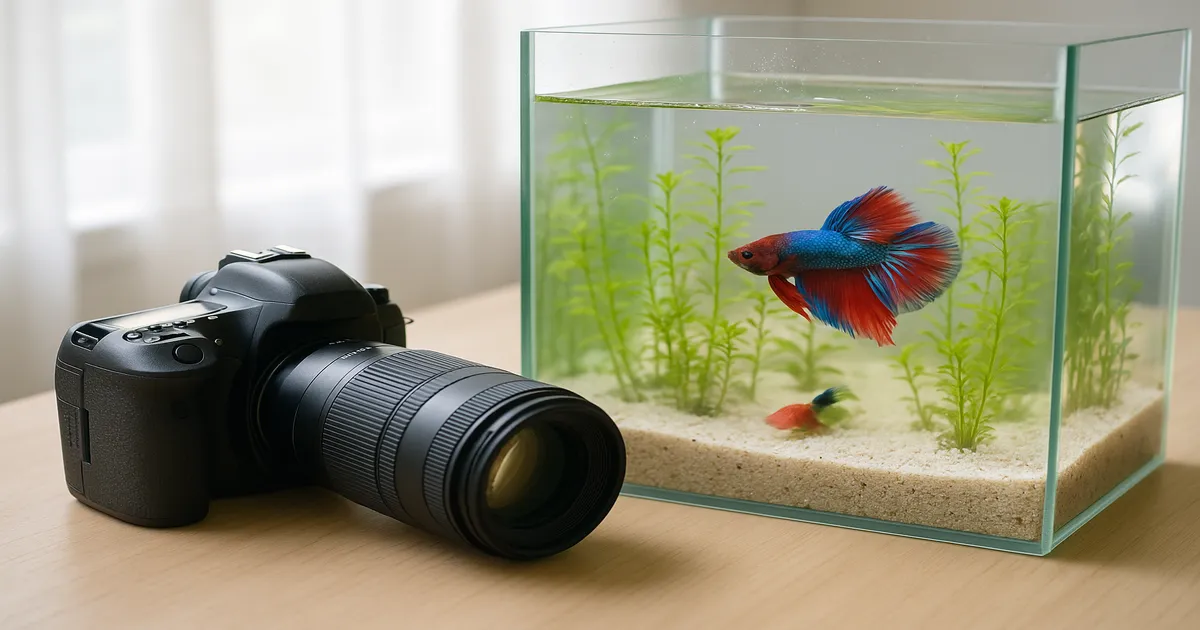
Quick Answer: The Sony a6400 is the best overall camera for aquarium photography — its real-time tracking autofocus is genuinely transformative for capturing fast-moving fish. On a budget, the Sony ZV-E10 delivers excellent AF and 4K video at roughly half the price, making it the ideal first “real camera” for serious aquarists.
If you’ve ever asked yourself does anyone else have 5,000 pictures of their fish and a folder of the 218 best ones? — welcome home. You’re among friends. Every single one of us has that folder. The brutal truth of fish photography is that the shot-to-keeper ratio is punishing: 50 attempts for every usable image is completely normal, and even experienced photographers delete far more than they keep. The good news is that the right camera and lens dramatically shift those odds. This guide breaks down the best options at every budget, explains exactly which specs matter for aquarium work, and helps you figure out which kit belongs in your hands.
Why Fish Photography Is So Hard
Even experienced aquarists have folders full of blurry, glare-wrecked rejects. That’s not a skill problem — it’s a physics problem. Four core challenges drive most of those failures.
Motion blur. A betta flaring at his reflection or a school of rummy-nose tetras making a sudden turn can cross the frame in a fraction of a second. Freezing that movement requires a shutter speed of at least 1/500s, often faster. That demands strong high-ISO performance to compensate in low light — and an autofocus system fast enough to track an unpredictable subject. Look for dedicated subject-tracking AF, not basic contrast-detect systems.
Glass reflections and refraction. Standard aquarium glass reflects ambient room light like a mirror. Water also bends light, shifting the apparent position of a fish and causing focus errors even when your AF locks on confidently. Shooting at a slight angle, pressing a rubber lens hood against the glass, and turning off room lights all help. A longer focal-length macro lens (90–100mm) keeps you further from the glass than a wide-angle, which is a meaningful practical advantage.
Low light and color rendering. Most planted tanks and reef setups run lower ambient light than cameras prefer for fast shutter speeds. Blue-heavy LED fixtures look stunning to the eye but render terribly on auto white balance — your orange discus turns grey, your neon tetras lose their electric blue. You need usable ISO performance at 1600–3200, and you’ll want to set a manual white balance matched to your tank lighting. High-CRI (90+) lighting on the tank itself matters just as much as camera settings.
Depth of field in three dimensions. Fish don’t stay in a flat plane — they swim toward you, away from you, and at every diagonal angle in between. At f/2.8 with a macro lens, your depth of field can be measured in millimeters. Micro Four Thirds cameras have a hidden advantage here: their smaller sensor produces more depth of field at equivalent apertures, making it genuinely easier to get an entire fish sharp in a single frame.
Does Anyone Else Have 5,000 Pictures of Their Fish? The Camera Comparison
| Product | Best For | Key Feature | Price |
|---|---|---|---|
| Sony ZV-E10 | Budget mirrorless entry | Subject tracking AF + 4K video | $ |
| Canon EOS Rebel SL3 | Budget DSLR loyalists | Dual Pixel live-view AF | $ |
| Sony a6400 | Best overall APS-C | Real-time tracking AF | $$ |
| Olympus OM-D E-M10 Mark IV | Handheld shooting | 5-axis IBIS | $$ |
| Fujifilm X-T5 | Color accuracy + print quality | 40MP + film simulations | $$$ |
| Sony a7 IV | Premium / semi-pro | Full-frame + IBIS + tracking AF | $$$$ |
| Canon/Nikon 100mm f/2.8 Macro | Canon/Nikon shooters | Long working distance | $$ |
| Sony FE 90mm f/2.8 Macro G OSS | Sony mirrorless bodies | Built-in OSS stabilization | $$$ |
| Olympus M.Zuiko 60mm f/2.8 Macro | Micro Four Thirds bodies | Exceptional sharpness + value | $$ |
How to read this table: On a budget, prioritize AF system quality and usable ISO over resolution — a sharp, well-tracked 24MP shot beats a blurry 40MP one every time. If you shoot handheld without a tripod (which is most people), weight IBIS heavily. Lens choice often matters as much as body choice, so factor both into your budget from the start.
Sony ZV-E10 — Best Budget Mirrorless for Aquarium Photography
The ZV-E10 is the obvious step up from smartphone photography for aquarists who are ready to get serious without spending four figures. Its APS-C sensor handles low light noticeably better than any phone camera, and the subject tracking AF — while not as sophisticated as the a6400’s — does a creditable job following fish across the frame. The 4K video capability is a genuine bonus for capturing schooling behavior and feeding frenzies.
Key specs: APS-C sensor, ~24MP · Real-time subject tracking AF · 4K video · No IBIS · ~$550 body only
Pros
- Affordable entry into the Sony APS-C ecosystem
- Subject tracking AF handles moving fish better than most phones
- 4K video excellent for documenting fish behavior
- Lightweight and compact; easy to maneuver around tanks
Cons
- No IBIS — handheld shots suffer in low light
- Kit 16–50mm lens is limiting for close-up work; a macro lens adds to the total cost
- No viewfinder, which some shooters find disorienting
Best for: The aquarist who has outgrown their phone but doesn’t want to spend four figures.
Canon EOS Rebel SL3 — Best Budget DSLR for Fish Tank Photos
The SL3 earns its place here primarily because of Dual Pixel AF in live view. For aquarium shooting — where you’re almost always composing on the rear screen rather than through the viewfinder — Dual Pixel AF is genuinely excellent, tracking subjects smoothly and accurately. It’s also the lightest DSLR on the market, which matters more than you’d think during extended sessions crouched in front of a tank.
Key specs: APS-C sensor, 24MP · Dual Pixel CMOS AF (live view) · No IBIS · ~$650 with kit lens
Pros
- Dual Pixel live-view AF is outstanding for aquarium photography
- Lightest DSLR available — comfortable for extended sessions
- Large Canon lens ecosystem with excellent macro options
- Intuitive controls; genuinely beginner-friendly
Cons
- No IBIS; handheld low-light shots require higher ISO or faster glass
- DSLR form factor is bulkier than mirrorless alternatives at the same price
- Kit 18–55mm lens is mediocre for fish close-ups
Best for: The DSLR loyalist who wants Canon’s familiar ergonomics and excellent lens ecosystem — though mirrorless alternatives offer better value at this price point in 2024.
Sony a6400 — Best Overall Camera for Aquarium Photography
The a6400’s real-time tracking AF is the single most impactful specification in this entire guide. It locks onto a subject and holds it through erratic movement with a tenacity that other cameras in this price range simply can’t match — and for fish photography, that’s the ballgame. Add usable ISO performance up to around 3200 and a flip-up screen that’s ideal for low-angle shots through the front glass, and you have a camera that feels purpose-built for this exact use case.
The only meaningful weakness is the absence of IBIS. If you shoot handheld in a dark room — and you probably do — compensate with a stabilized lens or lean on the faster shutter speeds the good high-ISO performance enables.
Key specs: APS-C sensor, 24MP · Real-time tracking AF · ISO up to 32000 (usable to ~3200) · 4K video · No IBIS · ~$900 body only
Pros
- Best-in-class AF tracking for APS-C — genuinely transformative for fast fish
- Excellent high-ISO performance for the price
- Flip-up screen ideal for low-angle tank shots
- Large Sony E-mount ecosystem, including the excellent 90mm macro
Cons
- No IBIS is a real limitation for handheld work in dark rooms
- Body-only price means additional budget needed for a quality macro lens
- Average battery life; carry a spare
Best for: Serious aquarium photographers who want the best autofocus performance in the APS-C class — our top overall pick.
Olympus OM-D E-M10 Mark IV — Best for Handheld Fish Photography
Here’s the honest truth about most aquarium photographers: they don’t use a tripod. They crouch in front of the tank, handhold the camera at odd angles, and hope for the best. If that’s you, the E-M10 Mark IV’s 5-axis IBIS is worth more than any other single specification on this list. It doesn’t compensate for subject motion — you still need a fast shutter — but it eliminates camera shake as a variable entirely, which is one less thing degrading your keepers.
The smaller Micro Four Thirds sensor gives up some high-ISO headroom compared to APS-C, but the tradeoff is a more forgiving depth of field that makes it easier to get an entire fish sharp in a single frame.
Key specs: Micro Four Thirds sensor, 20MP · 5-axis IBIS · ~$700 body only · Compatible with Olympus 60mm f/2.8 Macro
Pros
- Outstanding 5-axis IBIS — a genuine game-changer for handheld aquarium work
- Compact and lightweight; easy to maneuver around the tank
- Olympus 60mm f/2.8 Macro is one of the sharpest macro lenses available at any price
- More forgiving depth of field than APS-C or full-frame at equivalent apertures
Cons
- Smaller sensor limits high-ISO performance versus APS-C competitors
- Micro Four Thirds lens ecosystem is smaller than Sony or Canon
- Less dynamic range than larger sensors in challenging mixed lighting
Best for: Aquarists who refuse to use a tripod — IBIS alone justifies choosing this over similarly priced Sony options.
Fujifilm X-T5 — Best for Color Accuracy and Print-Quality Fish Photos
The X-T5 is the enthusiast’s pick — the camera for aquarists who care deeply about how their photos look, not just whether they’re sharp. Fuji’s film simulations, particularly Velvia and Classic Chrome, render aquarium colors with a richness that typically requires significant post-processing on other systems. The 40MP sensor is almost comically generous for cropping when a fish refuses to cooperate with your intended composition.
One practical note: 40MP files are large. If the premise of this article is that you already have 5,000 photos of your fish and a folder of the 218 best ones, the X-T5 will accelerate your storage costs considerably. Budget for a large external SSD alongside the body.
Key specs: APS-C sensor, 40MP · IBIS · Film simulations (Velvia, Classic Chrome, etc.) · ~$1,700 body only
Pros
- Exceptional resolution enables aggressive cropping without quality loss
- Fuji color science produces stunning aquarium colors with minimal editing
- IBIS for handheld stability
- Outstanding build quality; feels like a serious tool
Cons
- Expensive for the APS-C class
- AF tracking not as strong as the Sony a6400 for fast-moving subjects
- 40MP files demand significant storage — ironic given the 5,000-photo problem
Best for: The aquarist who wants gallery-wall-worthy prints and is willing to pay for Fuji’s legendary color rendering.
Sony a7 IV — Best Premium Camera for Serious Fish Photography
This is overkill for most hobbyists — and that’s worth saying plainly. But if you’re serious enough about fish photography to invest at this level, the a7 IV produces results that are genuinely in a different category. The full-frame 33MP sensor delivers extraordinary dynamic range and high-ISO performance (usable to around ISO 6400), and the combination of real-time tracking AF plus IBIS makes it the most technically capable body reviewed here.
One technical caveat: full-frame combined with a macro lens produces razor-thin depth of field. Getting an entire fish sharp often requires stopping down to f/5.6 or f/8 — which then pushes your ISO higher. It’s a solvable problem, but it demands more from the photographer than an APS-C or Micro Four Thirds setup.
Key specs: Full-frame sensor, 33MP · Real-time tracking AF + IBIS · ISO up to 51200 (usable to ~6400) · 4K video · ~$2,500 body only
Pros
- Best overall image quality of any camera reviewed
- Outstanding high-ISO and dynamic range performance
- IBIS combined with OSS lens gives exceptional stabilization
- Class-leading AF tracking; excellent 4K video
Cons
- Very expensive — body only, before adding a $1,100+ macro lens
- Full-frame + macro = extremely shallow depth of field requiring precise technique
- Heavy; overkill for casual hobbyists
Best for: Photographers serious enough to invest $3,500+ in a body-and-lens kit — the a6400 gets you 90% of the way there for a third of the price, but the a7 IV gets you the rest.
Best Lenses for Aquarium Photography
A great lens on a modest body will outperform a mediocre lens on an expensive body. This is especially true for aquarium photography, where working distance, sharpness wide open, and close-focus capability matter enormously.
Canon/Nikon 100mm f/2.8 Macro — The Classic Choice
The 100mm macro is the workhorse of aquarium photography for good reason. Its longer focal length keeps the front element further from the glass, physically reducing reflections and giving you room to use a lens hood. It delivers 1:1 macro reproduction and is sharp wide open at f/2.8.
- Pros: Long working distance reduces reflections; 1:1 macro; sharp wide open; widely available used
- Cons: AF can hunt on older DSLR bodies; manual focus often needed for precise aquarium work
- Verdict: The best starting point for Canon and Nikon DSLR shooters — reliable, sharp, and available at a reasonable price.
Sony FE 90mm f/2.8 Macro G OSS — Gold Standard for Sony Shooters
The 90mm Macro G is the lens that turns the Sony a6400 into a near-perfect fish photography kit. Built-in optical stabilization (OSS) compensates for the a6400’s lack of IBIS, AF is fast and accurate, and the optics are razor sharp corner to corner at f/2.8.
- Pros: Built-in OSS compensates for no-IBIS bodies; excellent AF; exceptional sharpness
- Cons: Expensive; heavier than competing macro lenses
- Verdict: If you’re shooting Sony mirrorless, this is the lens to save up for.
Olympus M.Zuiko 60mm f/2.8 Macro — Best Value Macro Lens
The Olympus 60mm Macro is one of the sharpest lenses available at any price — a claim consistently backed by optical testing. On a Micro Four Thirds body it delivers an effective 120mm equivalent field of view, providing excellent working distance from the glass.
- Pros: Outstanding sharpness; compact and lightweight; excellent value; pairs perfectly with E-M10 Mark IV IBIS
- Cons: Only works on Micro Four Thirds bodies; no built-in stabilization (relies on body IBIS)
- Verdict: The best value macro lens in this roundup — if you’re shooting Micro Four Thirds, this is a no-brainer.
Budget alternative: Extension tubes fitted to your existing kit lens provide macro-like magnification for under $30. Results aren’t as sharp as a dedicated macro lens, but they’re a legitimate way to test whether macro fish photography is worth the investment before committing.
Our Verdict: Which Fish Photography Camera Should You Buy?
Best Overall: Sony a6400. The real-time tracking AF is the most practically impactful specification for aquarium photography, full stop. If you can only buy one camera for this purpose, this is it.
Best Budget Pick: Sony ZV-E10. Genuinely capable subject tracking and 4K video at a price that leaves room in the budget for a decent macro lens. The best first step up from a smartphone.
Best for Handheld Shooting: Olympus OM-D E-M10 Mark IV. If you’re not going to use a tripod — and let’s be honest, most of us aren’t — the 5-axis IBIS eliminates camera shake as a problem entirely. Pair it with the Olympus 60mm Macro for a remarkably capable kit.
Best for Color and Print Quality: Fujifilm X-T5. For aquarists who want prints worth framing, Fuji’s color science and 40MP resolution are hard to argue with. Just budget for extra storage.
Best Premium Option: Sony a7 IV. When only the best will do. Results are genuinely in a different league — but the a6400 is the smarter purchase for the vast majority of hobbyists.
Best Lens to Buy First: Canon/Nikon 100mm f/2.8 Macro (or the Sony FE 90mm G OSS for Sony bodies). Start with the macro lens that matches your system and everything else follows.
Don’t Overlook Your Tank Setup
Here’s the honest truth that no camera review will tell you: upgrading your tank will improve your photos more than upgrading your camera. Low-iron glass (sometimes sold as Starphire or Optiwhite) eliminates the green tint that plagues standard aquarium glass. A solid black background makes fish colors pop. High-CRI lighting (90+) renders colors accurately without the color-cast problems that plague blue-heavy reef LEDs. And crystal-clear water — maintained through regular water changes and quality filtration — is non-negotiable for sharp images.
Fix the tank first, then invest in the camera. And yes — having 5,000 photos of your fish and a folder of the 218 best ones is completely normal. It’s not a problem to solve; it’s evidence that you care. The right gear just means more of those 5,000 are worth keeping.
Frequently Asked Questions About Fish and Aquarium Photography
Why are all my fish photos blurry even with a good camera?
Blurry fish photos almost always come down to three causes. Motion blur — your shutter speed is too slow; try 1/500s as a minimum and go faster for active fish. Focus error from refraction — water bends light and shifts the apparent position of the fish, causing your AF to lock on the wrong point; try manual focus or repositioning slightly off-axis. Camera shake — use a tripod or a camera with IBIS, especially in low light.
Is a smartphone good enough for aquarium photography?
Modern flagship phones — the iPhone 15 Pro and Samsung Galaxy S24 Ultra, for example — are genuinely capable for casual tank shots in good light. Where they fall apart is fast movement combined with low light, which is exactly the condition most aquarium photography happens in. A dedicated camera with a macro lens produces noticeably better results, especially for small, fast fish or detailed fin photography.
What camera settings should I use for fish photography?
Start with Shutter Priority mode and set a minimum of 1/500s — faster for very active fish. Let the camera choose ISO automatically, or set it manually up to the usable limit of your body (around ISO 3200 for most APS-C cameras). Use spot or zone AF rather than wide-area AF to avoid locking on the background through the glass. Set a manual white balance matched to your tank lighting rather than relying on auto white balance, which will be confused by colored LEDs.
How do I reduce glare and reflections when photographing my fish tank?
Shoot at a slight angle to the glass rather than straight on — this deflects reflected room light out of frame. Press a rubber lens hood or a piece of black foam against the glass to block ambient light at the point of entry. Turn off lights in the room behind you. A circular polarizing filter can also help, though it costs you about two stops of light. Long-focal-length macro lenses (90–100mm) naturally keep you further from the glass, which reduces the reflection problem compared to wide-angle shooting.
What is the best way to organize thousands of aquarium photos?
Adobe Lightroom is the tool most serious photographers use for culling and rating — the star-rating and flag system makes it straightforward to build that “folder of 218 best ones” systematically. For backup, Google Photos or Amazon Photos (free with Prime) provide cloud redundancy. For local storage, a large-capacity external SSD is faster and more durable than a spinning hard drive. The “folder of best ones” workflow you’re already using is a legitimate curation strategy used by professional photographers — the only upgrade is using proper rating tools to make the culling process faster.