Quick Answer: No — your betta fish does not like getting stuck in the filter, and she is absolutely not choosing it. Filter intake suction overpowers small fish, especially long-finned varieties like Halfmoons and Veiltails. The good news: this is a fixable husbandry problem, not a sign of a sick or strange fish.
If you’ve ever searched “does my betta fish like getting stuck in the filter or is it against her will?” — you’re asking exactly the right question. No betta voluntarily presses herself against a filter intake. What you’re seeing is physics overpowering a small fish, and it needs to be fixed before it causes real harm.
This article covers why it happens, which bettas are most at risk, and exactly how to stop it.
Does Your Betta Like Being Stuck in the Filter? Never.
Bettas are not drawn to filter intakes for fun or comfort. The suction created by an intake is genuinely powerful relative to a small fish’s body. Once fins or a body gets pulled against the screen, the fish often cannot swim free on her own. Think of it as the aquatic equivalent of being pinned against a drain — frightening, exhausting, and potentially fatal.
What Is Actually Happening When a Betta Gets Stuck
The filter draws water inward through its intake tube. That inward pull creates a suction zone directly in front of the screen. A betta swimming too close — or one too lethargic to swim away — gets drawn in, and her fins get held against the screen. Long, flowing fins make this far worse because they dramatically increase the surface area that suction can grab.
This is a husbandry issue, not a fish issue. Cover the intake, reduce the flow, or switch filter types — and the problem disappears.
Why Betta Fish Are So Vulnerable to Filter Suction
Natural Habitat: Slow, Still, and Shallow Water
Betta splendens evolved in the rice paddies, roadside ditches, floodplains, and shallow ponds of Thailand, Cambodia, Vietnam, and Laos. These are slow-moving or completely stagnant environments — often murky, heavily vegetated, and oxygen-poor. A betta’s entire physiology is calibrated for still water. Strong current isn’t just uncomfortable; it’s genuinely foreign to their biology.
The Labyrinth Organ and Surface Access
Bettas possess a labyrinth organ — a specialised structure above the gills that lets them breathe atmospheric oxygen directly from the surface. This isn’t optional; it’s essential. A current strong enough to push your betta away from the surface doesn’t just annoy her — it actively interferes with her ability to breathe. Flow rate is a health issue, not just a comfort preference.
Which Bettas Are Most at Risk?
The more elaborate the fins, the more surface area suction can grab.
Most vulnerable: Halfmoon, Rosetail, Feathertail, Veiltail, and Double Tail bettas — any variety with large, flowing fins.
Less vulnerable but still at risk: Plakat bettas have shorter fins and are stronger swimmers. They’re less likely to be pinned, but they may approach intakes out of curiosity — so they’re not immune, just differently at risk.
Why Bettas Get Stuck in Filters: The Real Causes
Unguarded Filter Intakes
Most standard filters — hang-on-back (HOB), internal, and canister — have open or minimally screened intake tubes. The holes in many intake screens are large enough for fins to be drawn through. Even when the fish’s body can’t enter, fins can be snagged and held, leaving your betta pinned and struggling.
Filter Flow That Is Too Strong
A filter rated for a 20-gallon tank installed in a 5-gallon tank isn’t “extra clean” — it’s a current machine. The flow has nowhere to dissipate, and your betta is essentially living in a washing machine. Even a correctly sized filter can be too strong if it isn’t baffled, because the output current creates circular flow that eventually pushes water — and your fish — back toward the intake.
Nano tanks under 5 gallons amplify every flow problem. The smaller the tank, the less distance between output and intake, and the less water volume to absorb and diffuse the current.
Cold Water and Poor Water Quality
A healthy betta in warm, clean water actively swims and can resist moderate current. A cold or water-quality-compromised betta cannot. When water drops below 74°F (23°C), metabolism slows, she becomes sluggish, and she may sink passively toward the intake rather than swimming away. High ammonia or nitrite levels cause the same problem — a lethargic fish is a vulnerable fish.
”Does My Betta Fish Like Getting Stuck in the Filter?” — How to Fix It
Best Filter Types for Betta Fish
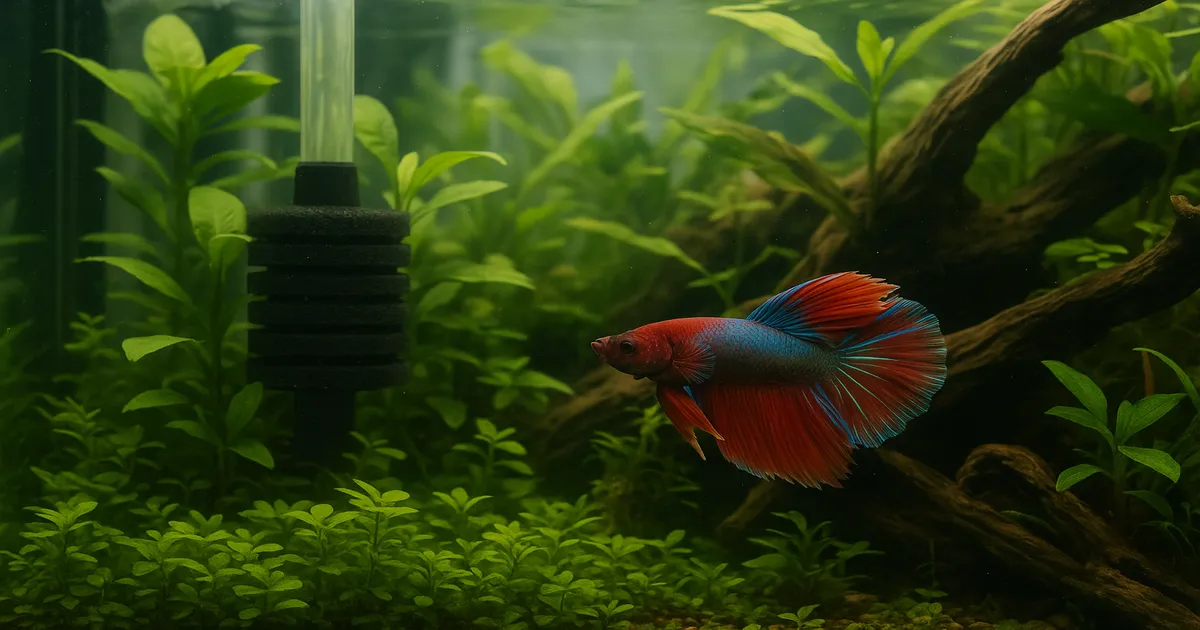
Sponge filters are the gold standard. They’re air-driven, produce gentle flow, and have no intake tube at all — so there’s simply nothing for a betta to get stuck on. Beneficial bacteria colonise the foam, providing excellent biological filtration. For a 5–10 gallon betta tank, a sponge filter is hard to beat. A reliable option is the Hikari Bacto-Surge Sponge Filter, which is sized well for smaller betta setups.
HOB filters can work well, but they need a pre-filter sponge over the intake and a baffled output. The AquaClear 20 is a popular choice because its flow rate is adjustable — a useful feature for betta tanks.
Internal filters on their lowest setting, with a sponge pre-filter, are acceptable. Canister filters are generally overkill for betta tanks and require significant baffling to be safe.
Pre-Filter Sponges: The Fastest Fix
A pre-filter sponge — a foam sleeve that slides over the intake tube — is the single fastest solution to the stuck-betta problem. It costs a few dollars, eliminates the suction hazard entirely, and actually improves biological filtration by adding more surface area for beneficial bacteria. It should be on every HOB or internal filter in a betta tank. The Aquaneat Bio Sponge Pre-Filter fits most standard intake tubes and is easy to rinse during water changes.
How to Baffle a Hang-On-Back Filter
Baffling reduces output velocity so it doesn’t blast your betta across the tank:
- Sponge over the output: Cut a piece of coarse filter sponge to fit over the outflow — it breaks up the current significantly.
- Plastic bottle diffuser: A clean bottle with small holes cut into it, placed over the output spout, disperses flow in multiple directions.
- Spray bar attachment: Spreads output across a wider area, reducing velocity at any single point.
Flow Rate: How Many GPH Is Safe?
Target a maximum of 3–5× tank volume per hour in effective (post-baffle) flow. For a 10-gallon tank, that means no more than 30–50 GPH actually reaching your betta. Many HOB filters rated for 10 gallons push 100+ GPH — which is why baffling is non-negotiable.
Signs your flow is too strong:
- Betta struggling to swim forward against the current
- Fins pushed sideways while she’s stationary
- Constant hiding behind decor to escape the flow
- Resting on the bottom or pressed against the glass
- Being pulled toward or pinned against the intake
Plants and Decor as Natural Baffles
Dense planting is one of the most effective — and most natural — ways to reduce current. Anubias, Java fern, and Cryptocoryne break up flow throughout the mid and lower tank. Floating plants like Salvinia and Frogbit are especially valuable: they dampen surface turbulence, give your betta resting spots near the surface where she breathes, and diffuse light to reduce stress. Driftwood and caves create low-flow zones she can retreat to.
Water Parameters and Health
A healthy betta in warm, clean water is an active swimmer. A stressed, cold, or toxin-exposed betta drifts — and drifting fish end up at filter intakes.
Temperature
Bettas are tropical fish. Their ideal range is 76–82°F (24–28°C). Below 74°F (23°C), metabolism slows and lethargy sets in. A cold betta doesn’t swim purposefully; she sinks and drifts. Use a reliable heater — the Fluval E Series is accurate and has a built-in temperature alarm, which is worth having in a small tank where swings happen fast.
Ammonia, Nitrite, and Nitrate
Ammonia and nitrite damage gill tissue and impair the labyrinth organ. Even low levels can cause erratic swimming or loss of muscle control. Both must always read 0 ppm. Nitrates are less acutely toxic but cause lethargy and fin deterioration at chronically elevated levels — keep them below 20 ppm with regular 25–30% weekly water changes.
Test regularly with a liquid test kit. The API Freshwater Master Test Kit covers all the parameters you need and is far more accurate than strip tests.
Always treat tap water with a dechlorinator before water changes to neutralise chlorine and chloramine.
Betta Water Parameter Quick-Reference
| Parameter | Acceptable Range | Ideal Range |
|---|---|---|
| Temperature | 72–86°F (22–30°C) | 76–82°F (24–28°C) |
| pH | 6.0–8.0 | 6.5–7.5 |
| GH | 3–20 dGH | 5–15 dGH |
| KH | 3–8 dKH | 4–6 dKH |
| Ammonia | 0 ppm | 0 ppm |
| Nitrite | 0 ppm | 0 ppm |
| Nitrate | <40 ppm | <20 ppm |
Health Risks of Getting Stuck in a Filter
Fin Damage and Fin Rot
When fins are pulled against an intake screen, the tearing is immediate. Those ragged edges are open wounds — perfect entry points for the bacteria (Aeromonas, Pseudomonas) that cause fin rot. In a stressed fish, fin rot can progress quickly, eating through fin tissue and eventually reaching the body if untreated.
Exhaustion, Stress, and Internal Injury
Being held against a filter intake is a sustained physical struggle. A betta fighting to free herself burns energy rapidly, and chronic stress suppresses immune function. In small or juvenile bettas, a powerful intake can cause soft tissue or internal injuries if part of the body is drawn into a wide intake tube. This is rare with properly screened intakes but a real risk with damaged or missing screens.
Signs Your Betta Has Been Injured by the Filter
- Ragged, torn, or missing fin sections
- Lethargy and hiding after the event
- Clamped fins (held tight against the body)
- Loss of colour or pale patches
- Refusal to eat
- Gasping at the surface or unusual swimming posture
Act quickly. A betta pinned to an intake can drown — unable to reach the surface to breathe — or die of exhaustion. If you find her stuck, gently turn off the filter and let her swim free before assessing damage.
Frequently Asked Questions
Does my betta fish like getting stuck in the filter, or is it against her will?
It is always against her will. No betta chooses to be near a filter intake. The suction physically overpowers her, especially if she’s lethargic from cold water or poor water quality. If you’re seeing this happen repeatedly, it’s a sign the intake is unguarded, the flow is too strong, or both.
Why does my betta keep going near the filter intake?
The most likely explanation is that the current is pulling her there — not that she’s choosing it. A lethargic betta may drift passively toward the intake rather than actively swimming away. Sustained proximity to the intake almost always signals a flow or water quality problem worth investigating.
Can a betta fish get hurt by a filter?
Yes, and the injuries can be serious. Fins torn against intake screens create open wounds that quickly become infected, leading to fin rot. Sustained suction causes exhaustion and chronic stress. In severe cases, internal injuries are possible. A betta that cannot free herself and cannot reach the surface to breathe can drown.
How do I stop my betta from getting sucked into the filter?
The fastest fix is a pre-filter sponge over the intake tube — it eliminates suction at the surface immediately and costs very little. For a permanent solution, switch to a sponge filter, which has no intake at all. Also baffle your filter’s output to reduce overall flow, and make sure your tank is at least 5 gallons so the current has room to dissipate.
What is the best filter for a betta fish tank?
A sponge filter is the best choice for most betta setups. It produces gentle flow, provides excellent biological filtration, and has no intake tube — eliminating the entrapment risk entirely. If you prefer a hang-on-back filter, choose one appropriate for your tank size, baffle the output, and always use a pre-filter sponge over the intake.