Quick Answer: For a 5-gallon tank, a betta fish is the clear winner — stunning, interactive, and perfectly happy alone. For a 10-gallon community setup, guppies or white cloud mountain minnows are the most forgiving choices for beginners, tolerating early mistakes while keeping the tank lively and colourful.
Choosing the best fish for beginners in a small tank is genuinely exciting — but it’s also where most new hobbyists make their first costly mistakes. Stock the wrong species and you’ll deal with dead fish, aggression problems, or a tank that never quite works. Get it right, and even a humble 10-gallon becomes something you’ll want to stare at for hours. Every species in this guide is widely available, genuinely manageable for first-time fishkeepers, and well-suited to tanks under 20 gallons.
What Makes a Good Beginner Fish for a Small Tank?
Hardiness and Water Parameter Tolerance
This is the most important criterion, full stop. New tanks experience ammonia and nitrite spikes while the biological filter establishes itself, and a fish that crashes at the first sign of imperfect water will break your heart and your budget. Look for species that tolerate a reasonable range of pH, temperature, and hardness — not fish that demand laboratory-precision conditions.
Adult Size and Space Requirements
A fish that looks tiny in a store cup can become a serious problem in a 5-gallon tank. Always research adult size, not juvenile size. As a rough guide, small tanks work best with fish that stay under 2.5 inches — and even then, bioload and swimming behaviour matter as much as raw length.
Temperament and Schooling Needs
Peaceful, community-friendly fish make your life dramatically easier. Aggressive or territorial species force complex stocking decisions before you’ve even mastered water changes. It’s equally important to know whether your fish needs companions: tetras, corydoras, and danios are stressed and prone to disease when kept alone or in pairs, while a male betta must live alone. Getting this wrong costs both money and fish welfare.
Feeding Simplicity
Beginner-friendly fish should accept high-quality flake or pellet food as their staple diet. Species that require live food or specialised frozen diets add unnecessary complexity when you’re still learning the basics. Most fish on this list thrive on a quality tropical flake or micro-pellet with occasional treats.
Best Fish for Beginners in a Small Tank — At-a-Glance Comparison
| Species | Min. Tank Size | Adult Size | Temperature | pH Range | Schooling (Min.) | Heater Required | Aggression | Difficulty |
|---|---|---|---|---|---|---|---|---|
| Betta Fish | 5 gal | 2.5–3 in | 76–82°F | 6.5–7.5 | No (solitary) | Yes | High (male–male) | Easy |
| Guppy | 10 gal | 1–2.5 in | 72–82°F | 7.0–8.0 | No | Yes | Very Low | Very Easy |
| Platy | 10 gal | 1.5–2.5 in | 70–82°F | 7.0–8.2 | No | Yes | Very Low | Very Easy |
| Neon Tetra | 10 gal | 1–1.5 in | 70–81°F | 6.0–7.0 | Yes (6+) | Yes | Very Low | Easy |
| Corydoras | 10 gal* | 1–2.5 in | 72–79°F | 6.5–7.5 | Yes (6+) | Yes | Very Low | Easy |
| White Cloud Minnow | 10 gal | 1–1.5 in | 60–72°F | 6.5–7.5 | Yes (6+) | No | Very Low | Very Easy |
| Zebra Danio | 10 gal | 1.5–2 in | 65–77°F | 6.5–7.5 | Yes (6+) | No** | Very Low | Very Easy |
| Endler’s Livebearer | 5 gal | <1 in (m) | 72–82°F | 7.0–8.5 | No | Yes | Very Low | Very Easy |
*Pygmy corydoras (C. pygmaeus, C. habrosus) can work in 5 gallons. **Danios tolerate cooler temperatures but appreciate a heater in most home setups.
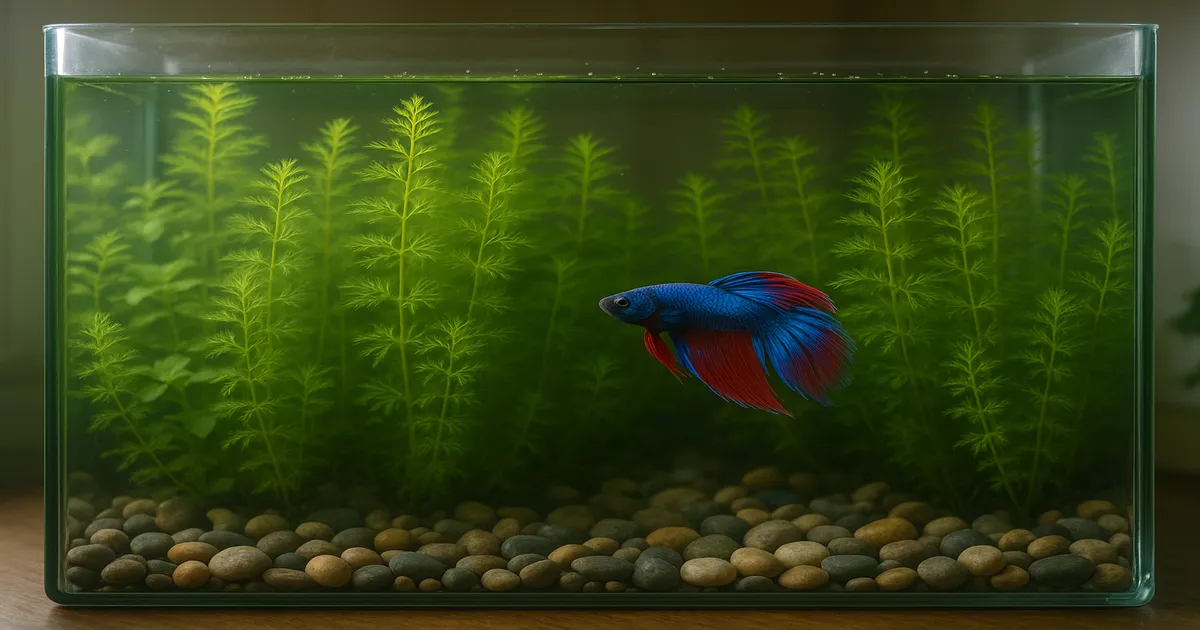
Betta Fish (Betta splendens)
The betta is the ultimate solo fish for a 5-gallon tank. Its labyrinth organ lets it breathe atmospheric air directly, which means it tolerates lower oxygen levels than most fish — a genuine safety net for beginners. Add stunning colour morphs (halfmoon, crowntail, dumbo ear), an interactive personality that recognises its owner, and you have a fish that punches well above its weight for the setup cost involved.
One honest caveat: captive-bred fancy varieties with elaborate fins are slightly more fragile than wild-type fish and need clean water to keep fin rot at bay. Keep flow low — a gentle sponge filter is ideal — and add floating plants like frogbit for resting spots near the surface.
Key specs:
- Size: 2.5–3 in
- Temperature: 76–82°F (24–28°C)
- pH: 6.5–7.5
- Minimum tank: 5 gallons
- Heater: Required
- Flow: Low
Pros
- Thrives alone — no schooling cost or complexity
- Wide variety of colour morphs and fin types
- Interactive and responsive to its owner
- Labyrinth organ provides a buffer against low oxygen
Cons
- Males cannot be housed together under any circumstances
- Fin-nipping tankmates cause serious, fast damage
- Fancy fin varieties are prone to fin rot without excellent water quality
- Sensitive to ammonia spikes — tank must be fully cycled before adding one
Best for: A single-species, beautifully planted 5-gallon setup. It’s the most rewarding beginner fish you can keep on its own.
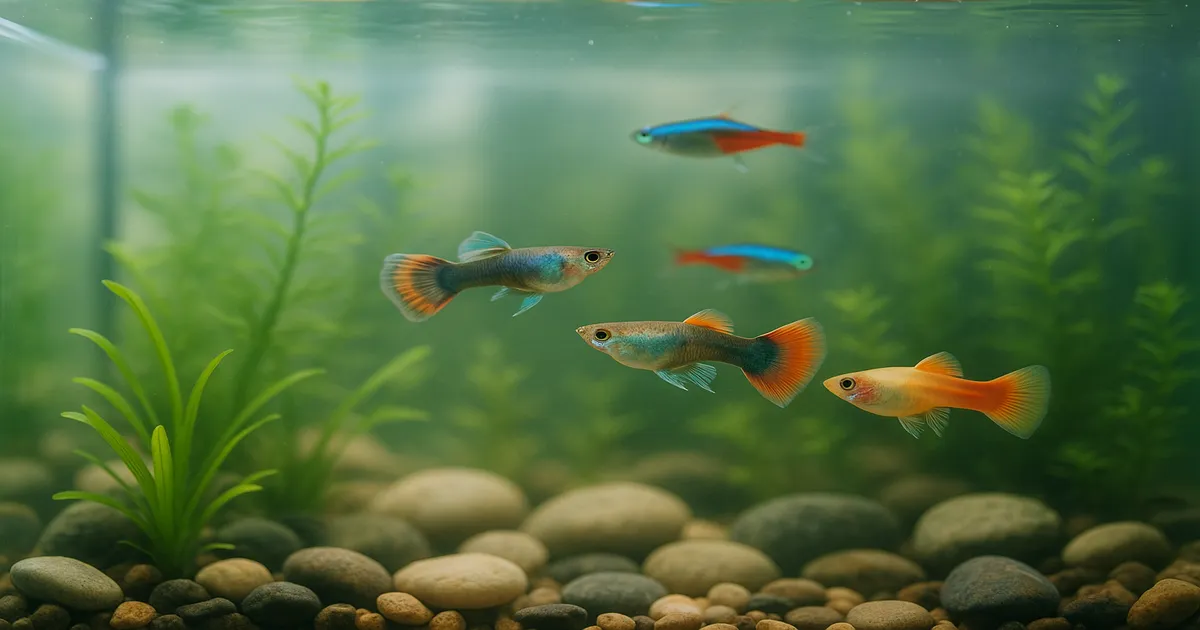
Guppy (Poecilia reticulata)
Guppies are arguably the most forgiving tropical fish in the hobby. They tolerate a wide range of water conditions, come in dozens of colour strains, and their constant active movement makes any tank feel alive. For a 10-gallon community setup, they’re hard to beat.
The one trap beginners fall into: buying a mixed-sex group. A single male-female pair can produce dozens of fry within weeks, and a small tank fills up fast. Stick to an all-male group — you get all the colour and activity with none of the population explosion.
Key specs:
- Size: 1–2.5 in
- Temperature: 72–82°F (22–28°C)
- pH: 7.0–8.0
- Minimum tank: 10 gallons
- Heater: Required
- Nitrate tolerance: Up to 40 ppm
Pros
- Extremely hardy and forgiving of beginner mistakes
- Colourful, active, and entertaining to watch
- Widely available and inexpensive
- No minimum schooling number required
Cons
- Mixed-sex groups breed rapidly and uncontrollably
- Males can harass females in close quarters
- Fancy strains are noticeably less hardy than standard guppies
- Short lifespan of 1–3 years compared to most other species here
Best for: The most beginner-proof tropical fish for a 10-gallon community tank, especially kept as an all-male group.
Platy (Xiphophorus maculatus / X. variatus)
Platies are stocky, peaceful livebearers that tolerate hard, alkaline tap water better than almost any other species on this list. If your tap water is on the harder side and you haven’t yet learned to condition it properly, platies will simply shrug it off. They’re also one of the few fish here that don’t need companions of their own kind, which simplifies stocking considerably.
Like guppies, they breed readily if you mix sexes — so keep an all-male group, or a single-sex group, in a small tank. Treat your water with a quality dechlorinator at every water change regardless of species.
Key specs:
- Size: 1.5–2.5 in
- Temperature: 70–82°F (21–28°C)
- pH: 7.0–8.2
- Minimum tank: 10 gallons
- Heater: Required
- Prefers: Moderately hard to hard water
Pros
- Extremely hardy with a wide pH and temperature tolerance
- Peaceful with virtually every other community fish
- No schooling requirement reduces stocking complexity
- Long lifespan of 3–5 years; multiple attractive colour variants available
Cons
- Prolific breeders if sexes are mixed
- May struggle in very soft tap water without mineral supplementation
- Less visually dramatic than bettas, neons, or fancy guppies
Best for: The most stress-free livebearer for beginners in hard-water regions, and an excellent first fish for anyone who wants to keep things genuinely simple.
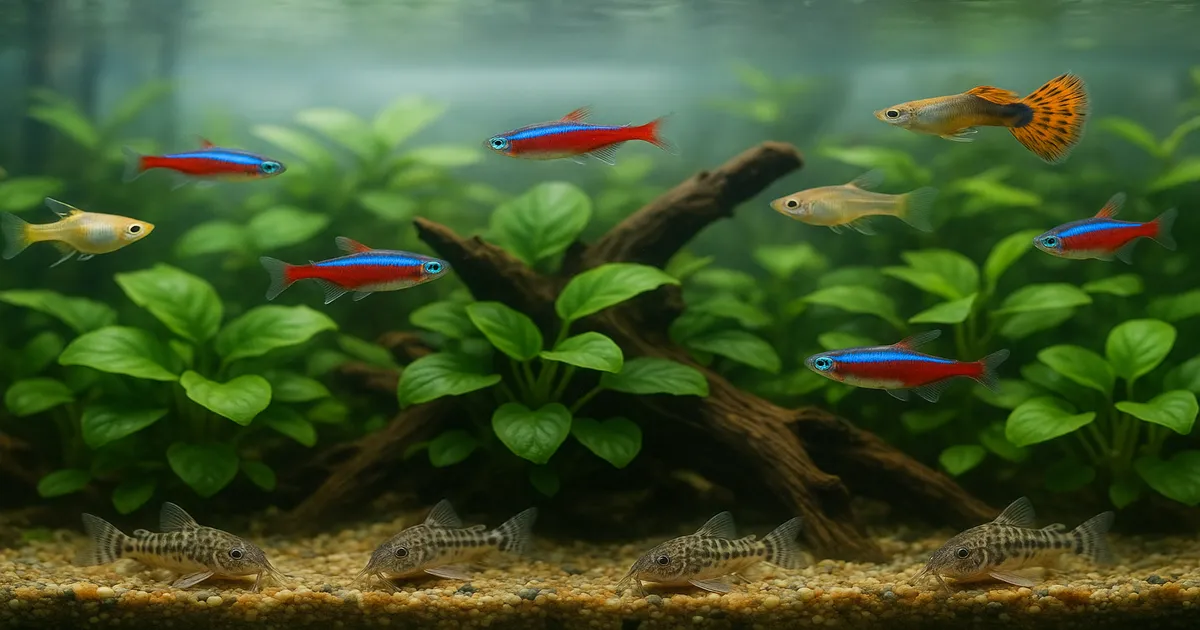
Neon Tetra (Paracheirodon innesi)
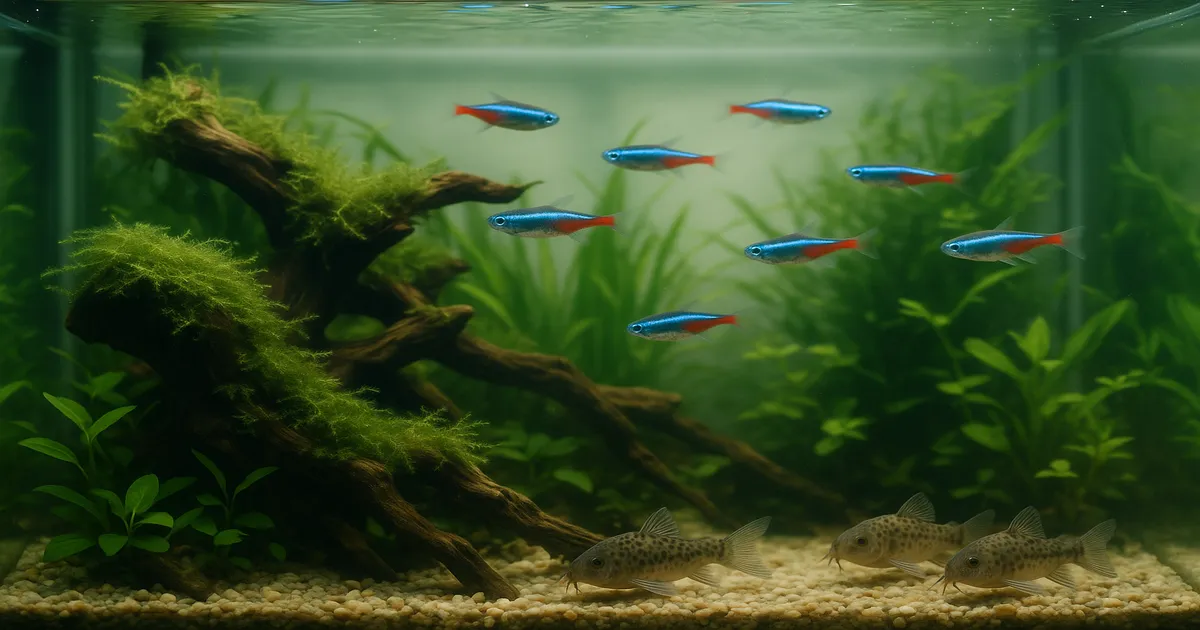
Neon tetras are iconic for a reason. That electric blue-and-red stripe is instantly recognisable, and a school of 8–10 in a planted tank is genuinely breathtaking — one of the best-looking displays you can achieve in a 10-gallon. They’re peaceful, long-lived in stable conditions, and available at virtually every fish store.
Here’s the honest caveat: neons are the most parameter-sensitive fish on this list. They must never go into an uncycled tank, and they prefer soft, slightly acidic water that hard tap water areas can’t provide without treatment. If you’re in a hard-water region, consider the ember tetra (Hyphessobrycon amandae) as a hardier nano alternative — smaller, similarly warm-coloured, and far more forgiving of water chemistry.
Key specs:
- Size: 1–1.5 in
- Temperature: 70–81°F (21–27°C)
- pH: 6.0–7.0
- Minimum tank: 10 gallons
- School: 6+ required (8–10 recommended)
- Heater: Required
Pros
- Iconic, instantly recognisable appearance
- Completely peaceful with all community species
- Long lifespan potential of 5–10 years in stable conditions
- Widely available and modestly priced
Cons
- Sensitive to ammonia spikes — tank must be fully cycled before adding them
- Prefer soft, acidic water; struggle in hard tap water without treatment
- Must be kept in groups of 6 or more — smaller numbers cause chronic stress
Best for: A stunning schooling display in a fully cycled, planted tank where water quality is stable and consistent.
Corydoras Catfish (Corydoras spp.)
Corydoras are the ideal bottom-dwelling companion for almost any small community tank. They scavenge uneaten food before it can rot and spike ammonia, they’re completely peaceful, and watching a group of six dart around the substrate together is genuinely entertaining. Their armoured bodies make them surprisingly tough despite their small size.
For nano tanks and 5-gallon setups, look specifically for pygmy corydoras (C. pygmaeus) or salt-and-pepper corydoras (C. habrosus) — both stay under 1.5 inches and are perfectly sized for smaller aquariums. Standard species like peppered cory (C. paleatus) need a 10-gallon minimum. One critical point: corydoras need fine sand substrate. Coarse gravel damages their sensitive barbels over time, leading to infections that are difficult to treat.
Key specs:
- Size: 1–2.5 in depending on species
- Temperature: 72–79°F (22–26°C)
- pH: 6.5–7.5
- Minimum tank: 10 gallons (pygmy species: 5 gallons)
- Group: 6+ required
- Substrate: Fine sand strongly preferred
Pros
- Peaceful cleanup crew that reduces uneaten food buildup
- Hardy and long-lived — 5–10+ years with good care
- Compatible with virtually every other species on this list
- Entertaining group behaviour and active personalities
Cons
- Require fine sand substrate — coarse gravel causes barbel damage and infection
- Must be kept in groups of 6 or more
- Some species grow too large for true nano setups
Best for: The best bottom-dweller and community companion for any beginner small tank — pair them with almost anything on this list.
White Cloud Mountain Minnow (Tanichthys albonubes)
White clouds are the only species on this list that genuinely thrive without a heater in most homes. They prefer temperatures of 60–72°F (15–22°C), which is room temperature in most houses year-round. That alone makes them the cheapest and simplest possible setup: no heater to buy, no heater to malfunction. They’re also bulletproof hardy, peaceful, and their subtle red-and-gold colouration looks beautiful in a school against green plants.
Long-fin and gold variants are widely available and add visual interest without any extra care requirements. Give them a decent filter with some flow — they come from fast-moving mountain streams and appreciate well-oxygenated water.
Key specs:
- Size: 1–1.5 in
- Temperature: 60–72°F (15–22°C)
- pH: 6.5–7.5
- Minimum tank: 10 gallons
- School: 6+ required
- Heater: Not required in most homes
Pros
- No heater required — significantly reduces setup cost and complexity
- Extremely hardy and tolerant of beginner mistakes
- Inexpensive to buy and easy to find
- Long-fin and gold variants available for added visual appeal
Cons
- Cannot be mixed with tropical fish requiring 78°F+ — temperature ranges don’t overlap
- Prefer some water current — need adequate filtration
- Less visually dramatic than bettas, neons, or guppies
Best for: The best beginner fish for anyone who wants a low-cost, low-equipment setup without a heater — especially in cooler homes.
Zebra Danio (Danio rerio)
Zebra danios are often called the most bulletproof tropical fish in the hobby, and it’s not hyperbole. They tolerate temperature swings, suboptimal water quality, and beginner mistakes that would kill more sensitive species outright. Their constant active movement — zipping back and forth across the tank in tight formation — makes any aquarium feel energetic and alive. GloFish danio variants (fluorescent colour morphs) are hugely popular with beginners and look particularly striking under blue LED lighting.
One thing to watch: danios can be fin-nippers with slow or long-finned tankmates. Don’t house them with bettas or fancy guppies.
Key specs:
- Size: 1.5–2 in
- Temperature: 65–77°F (18–25°C)
- pH: 6.5–7.5
- Minimum tank: 10 gallons
- School: 6+ required
- Heater: Beneficial but not strictly required in warm homes
Pros
- Extreme hardiness — tolerates beginner mistakes better than almost any other species
- Handles temperature fluctuations that would stress other tropical fish
- Active, entertaining, and visually appealing (especially GloFish variants)
- Widely available and very inexpensive
Cons
- Can fin-nip slow or long-finned tankmates — avoid pairing with bettas or fancy guppies
- Need open swimming space — heavy planting can frustrate them
- Prefer some water current; stagnant tanks don’t suit them well
Best for: The most forgiving schooling fish for absolute beginners who want an active, low-maintenance tank.
Endler’s Livebearer (Poecilia wingei)
Endler’s livebearers pack the colour and activity of guppies into a nano-sized package. Males stay under 1 inch and display vivid, intricate colouration that rivals any fancy guppy — yet they’re hardier than most fancy guppy strains and perfectly suited to 5–10-gallon setups. An all-male group gives you all the visual payoff with none of the breeding chaos.
Keep them away from bettas — their bright colouration and active movement trigger aggression. They can also hybridise with guppies if housed together, producing offspring of uncertain hardiness, so keep the two species separate.
Key specs:
- Size: Males under 1 in; females up to 1.5 in
- Temperature: 72–82°F (22–28°C)
- pH: 7.0–8.5
- Minimum tank: 5 gallons
- Heater: Required
- Tolerates: Hard, alkaline tap water well
Pros
- True nano-tank friendly — males under 1 inch
- Hardier than fancy guppy strains
- Stunning male colouration; multiple pattern varieties available
- Tolerates hard alkaline tap water without issue
Cons
- Bright males provoke betta aggression — cannot be housed together
- Will hybridise with guppies if kept in the same tank
- Females breed prolifically if kept with males in a small tank
Best for: The best nano-tank fish for beginners who want guppy-level colour in a 5-gallon setup without the breeding headache.
Our Verdict: Which Beginner Fish Is Right for Your Small Tank?
Best Overall for a 5-Gallon: Betta Fish
Nothing else comes close for a solo 5-gallon setup. The personality, the colour variety, and the interactive behaviour make it the most rewarding beginner fish you can keep in a small space.
Best Overall for a 10-Gallon Community: Guppies + Corydoras
An all-male guppy group of 4–6 paired with 6 corydoras is one of the most reliable, colourful, and low-maintenance communities you can build in a 10-gallon. Both species are forgiving, widely available, and genuinely entertaining to watch.
Best Budget Setup (No Heater): White Cloud Mountain Minnows
Six white clouds in a 10-gallon with a sponge filter and some java fern is about as inexpensive and foolproof as fishkeeping gets. Perfect for anyone on a tight budget or living in a cool climate.
Best for Absolute Beginners Who Want a Schooling Fish: Zebra Danios
If you’re worried about making mistakes — and all beginners should be a little worried — zebra danios are your safety net. Start with a school of 6 in a 10-gallon and learn the hobby without the anxiety of keeping sensitive fish.
Best Nano Fish for a Planted Tank: Endler’s Livebearers
A group of 6–8 male Endler’s in a heavily planted 5–10-gallon is a stunning display. Add a few pygmy corydoras for the bottom layer and you have a complete, self-contained nano community.
Best for Hard Tap Water: Platies
If your tap water is hard and alkaline, platies will thrive where other species struggle. They’re peaceful, long-lived, and completely undemanding about water chemistry.
Best for a Stunning Display Tank: Neon Tetras (cycled tank required)
A school of 8–10 neons with 6 corydoras in a planted 10-gallon is genuinely one of the most beautiful setups in the hobby. Just make sure your tank is fully cycled before they go in — use a liquid test kit to confirm ammonia and nitrite are both at 0 ppm.
Suggested 10-gallon community combinations:
- 1 male betta + 6 pygmy corydoras + floating plants
- 8 neon tetras + 6 corydoras (fully cycled tank required)
- 6 white cloud mountain minnows + 6 corydoras (no heater needed)
- 6 male guppies + 6 corydoras
- 8 male Endler’s livebearers + 4 pygmy corydoras
Always cycle your tank before adding fish, match tankmates by temperature and water hardness, and buy from a reputable local fish store or trusted online retailer to get healthy stock from the start.
Frequently Asked Questions
What is the easiest fish to keep in a small tank?
For a solo setup, the betta fish is the easiest — it needs only a 5-gallon tank, no companions, and tolerates lower oxygen levels than most fish thanks to its labyrinth organ. For a community setup without a heater, white cloud mountain minnows are arguably even more forgiving, thriving at room temperature and tolerating a wide range of beginner mistakes. Both are widely available and inexpensive to start with.
How many fish can I put in a 10-gallon tank?
The old “1 inch of fish per gallon” rule is a rough starting point, but it doesn’t account for bioload, swimming behaviour, or filtration quality. A practical guideline for a 10-gallon: a school of 6–8 nano fish (like neons or white clouds) plus 4–6 corydoras, or an all-male guppy group of 4–6 with a small cory group. Overstocking leads to ammonia spikes and chronic stress — when in doubt, stock lighter and do more frequent water changes.
Can I keep a betta fish with other fish in a small tank?
Yes, but carefully. The safest companions for a betta in a 5–10-gallon are pygmy corydoras, nerite snails, and mystery snails — bottom-dwellers or slow-movers that don’t trigger aggression. Avoid male guppies, Endler’s livebearers, and any fin-nipping species like tiger barbs. Even “safe” tankmates can provoke aggression in some individual bettas, so always have a backup plan if your specific fish won’t tolerate company.
Do beginner fish need a heater?
Most tropical fish do. Bettas, guppies, platies, neon tetras, and corydoras all need water kept at 76–82°F (24–28°C), which requires a heater in most homes. The exceptions on this list are white cloud mountain minnows (60–72°F) and zebra danios (65–77°F), both of which can manage at typical room temperature. If your home drops below 65°F in winter, even these species will benefit from a small adjustable heater.
What fish can live together peacefully in a small aquarium?
The most reliable peaceful combinations for a 10-gallon include: neon tetras + corydoras, male guppies + corydoras, white cloud mountain minnows + corydoras, and male Endler’s livebearers + pygmy corydoras. The key principles are matching temperature requirements, avoiding known fin-nippers with long-finned species, and always keeping schooling fish in groups of six or more. A single male betta can also coexist peacefully with pygmy corydoras or snails in a well-planted 10-gallon, provided the tank is large enough for the betta to establish its own territory.