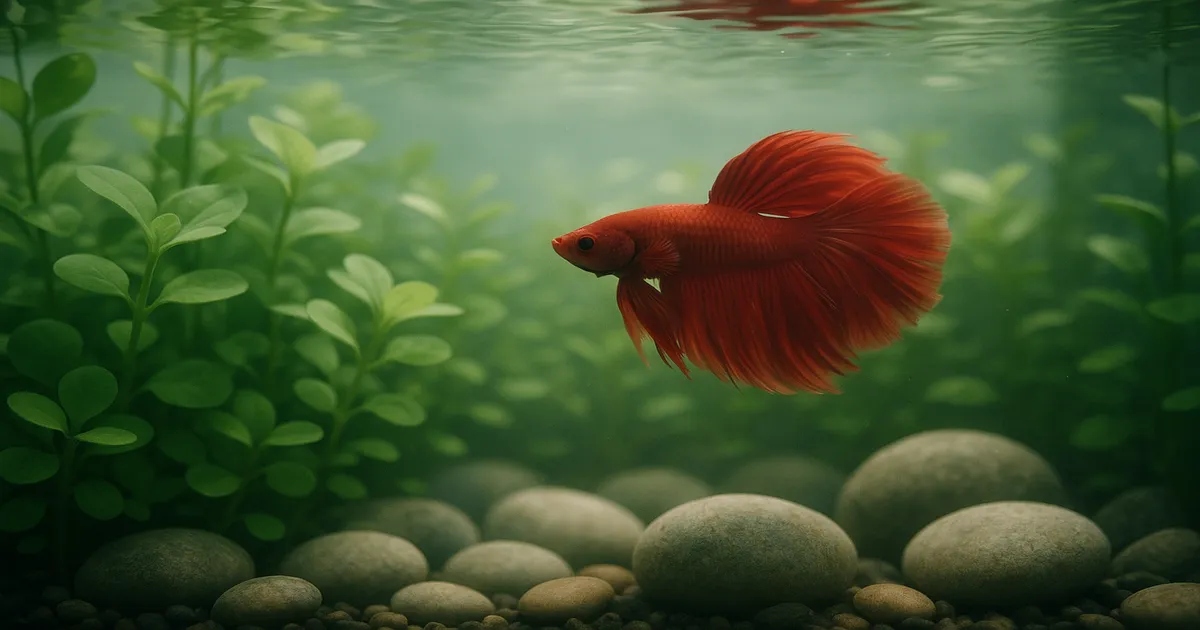
Quick Answer: Yes, you should rescue a blind betta — they can live full, happy lives with the right setup. The commitment is real: blind bettas need a stable tank layout, targeted feeding, and more attentive daily care than sighted fish. If you can offer that, rescuing one is absolutely worth it.
Should You Rescue a Blind Betta? What to Expect
How Blind Bettas Are Different from Sighted Bettas
Blind bettas aren’t broken — they’re just working with a different toolkit. Instead of vision, they navigate using their lateral line system (which detects water pressure and vibration), their sense of smell, and in many cases, residual light-and-shadow perception. They can find food, recognize their territory, and live comfortably as long as their environment supports them.
The practical differences come down to three things: how you feed them (tongs or pipette, not just dropping food in the water), tank layout stability (never rearrange their décor — they memorize it), and flow control (strong currents are genuinely dangerous for a fish that can’t see where it’s being pushed).
Honest Commitment Checklist Before You Decide
Before you say yes to a blind rescue betta, run through this quickly:
- Time: Can you hand-feed once or twice daily and remove uneaten food within 2–3 minutes?
- Budget: Do you have — or can you set up — a cycled 10-gallon tank with a sponge filter, heater, and thermometer?
- Stability: Are you willing to leave the tank layout unchanged once it’s established?
- Patience: Rescue bettas may be stressed, underweight, or ill. Recovery takes weeks, not days.
If you checked all four, you’re ready.
What Causes Blindness in Betta Fish?
Cataracts: The Most Common Cause
Cataracts appear as a cloudy, white, or opaque lens — the eye looks milky but doesn’t bulge. They’re most often linked to age, nutritional deficiencies (particularly vitamins A and C), or the aftermath of infection. Fish cataracts are irreversible. The goal isn’t treatment — it’s optimizing the tank so the fish thrives anyway.
Popeye Disease and Eye Rupture
Popeye (exophthalmia) is a bacterial infection — typically Aeromonas or Pseudomonas — that causes the eye to protrude visibly from the socket. Left untreated, the eye can rupture entirely, leaving permanent blindness. It’s almost always triggered by poor water quality or physical injury, which is why rescue bettas are particularly vulnerable.
Bacterial Infections, Trauma, and Parasites
Bacterial or fungal corneal infections can scar eye tissue and permanently cloud vision. Physical trauma — from aggressive tank mates, sharp decorations, or rough handling — can damage the eye directly. Severe velvet (Oodinium) infections can also cause eye damage if left untreated long enough.
Genetic and Congenital Blindness
Heavy line-breeding in fancy betta varieties (halfmoon, rosetail, dumbo ear) occasionally produces fish with congenital eye abnormalities. These bettas are born with compromised vision and often end up in rescue situations through no fault of their previous keeper.
Partial vs. Total Blindness
True total blindness is less common than you might think. Many “blind” bettas still detect light and shadow, respond to day/night cycles, and orient themselves by ambient light levels. Consistent lighting on a timer still benefits them, and sudden bright flashes can startle them even if they can’t form a clear image.
Ideal Water Parameters for a Blind Betta
Water chemistry requirements for a blind betta are identical to those for a sighted betta — the difference is how carefully you manage them.
| Parameter | Ideal Range | Acceptable Range |
|---|---|---|
| Temperature | 78–80°F (25.5–26.7°C) | 76–82°F (24–28°C) |
| pH | 6.8–7.0 | 6.5–7.5 |
| GH | 3–8 dGH | 2–12 dGH |
| KH | 3–5 dKH | 2–8 dKH |
| Ammonia | 0 ppm | — |
| Nitrite | 0 ppm | — |
| Nitrate | <10 ppm (rescue fish) | <20 ppm |
Use a reliable submersible heater with a built-in thermostat, and always verify the reading with a separate thermometer — heater thermostats drift over time.
Why Ammonia and Nitrite Must Always Be Zero
Even trace ammonia (0.25 ppm) causes gill damage and immune suppression in healthy fish. For a blind rescue betta that’s already stressed and potentially immunocompromised, it can turn fatal surprisingly fast. Test weekly with a liquid test kit and keep a bottle of dechlorinator on hand — one that temporarily detoxifies ammonia and nitrite in emergencies. (Seachem Prime)
Stability Over Perfection
A pH of 7.2 that never moves is safer than a pH of 6.9 that swings to 7.6 after water changes. Blind bettas can’t easily escape temperature gradients or chemical spikes by swimming to a better part of the tank — they may not even detect the problem until they’re already in distress. Cycle your tank fully before adding any rescue fish, and keep water changes slow and consistent (no more than 25–30% at a time).
Setting Up the Perfect Tank for a Blind Betta
Tank Size
A 5-gallon tank is the absolute minimum for any betta. For a blind rescue fish, 10 gallons is strongly recommended. Larger tanks maintain more stable parameters, dilute waste more effectively, and give a blind betta enough space to build a reliable mental map without constant disorientation.
Substrate
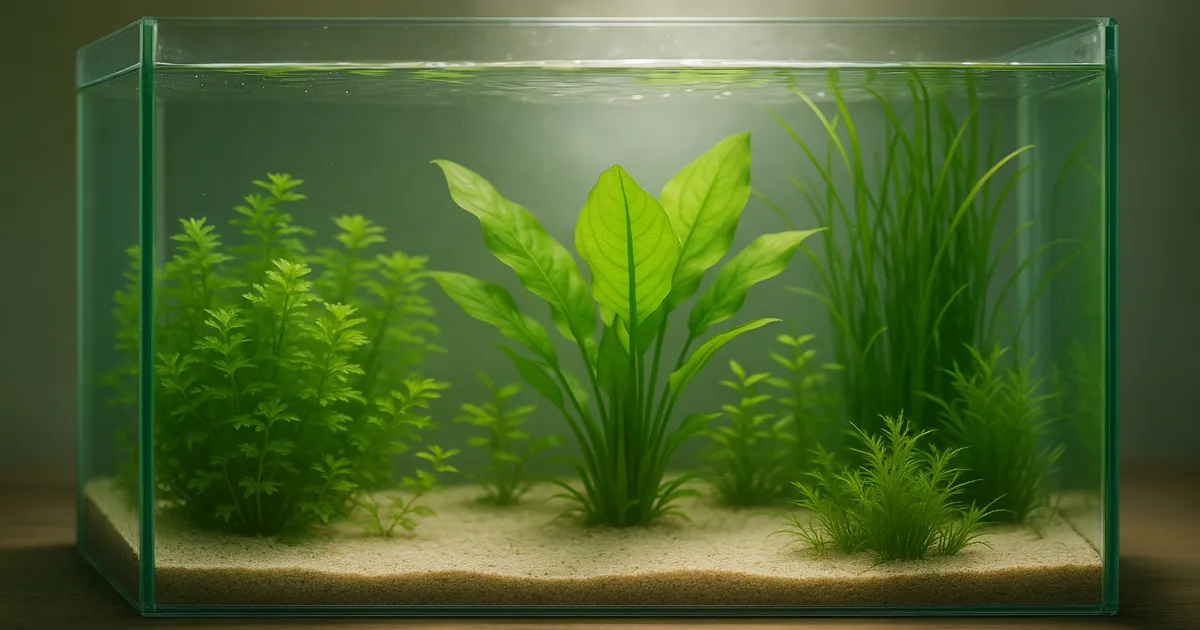
Fine-grain sand — pool filter sand or CaribSea Super Naturals — is the best choice. It’s soft, won’t injure a fish that bumps the bottom while navigating, and looks natural. Smooth rounded gravel works too. Avoid anything sharp or coarse.
Plants and Decorations
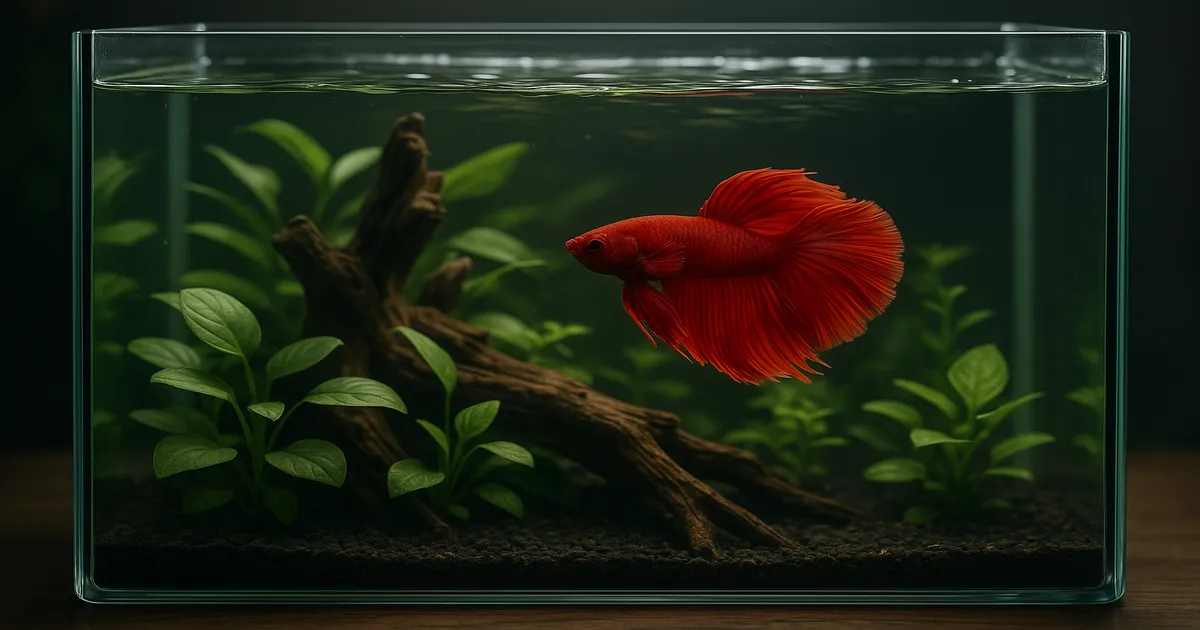
Think of your tank layout as a map your betta will memorize. Once it’s set up, don’t change it. Rearranging decorations forces a blind betta to relearn its entire environment from scratch — that’s genuinely stressful for the fish.
Good plant choices:
- Anubias and Java fern — tough, low-light, attach to hardscape; great mid-tank landmarks
- Floating plants (frogbit, water lettuce) — calm the surface, diffuse harsh light, and give the betta a tactile reference point right where it needs to breathe
- Betta hammocks placed within 2–3 inches of the surface so the fish can rest without exhausting itself swimming up repeatedly
Before adding any hard decoration, run the nylon stocking test: drag a stocking across every surface. If it snags, that decoration will shred fins — and a blind betta can’t dodge edges it can’t see.
Filtration
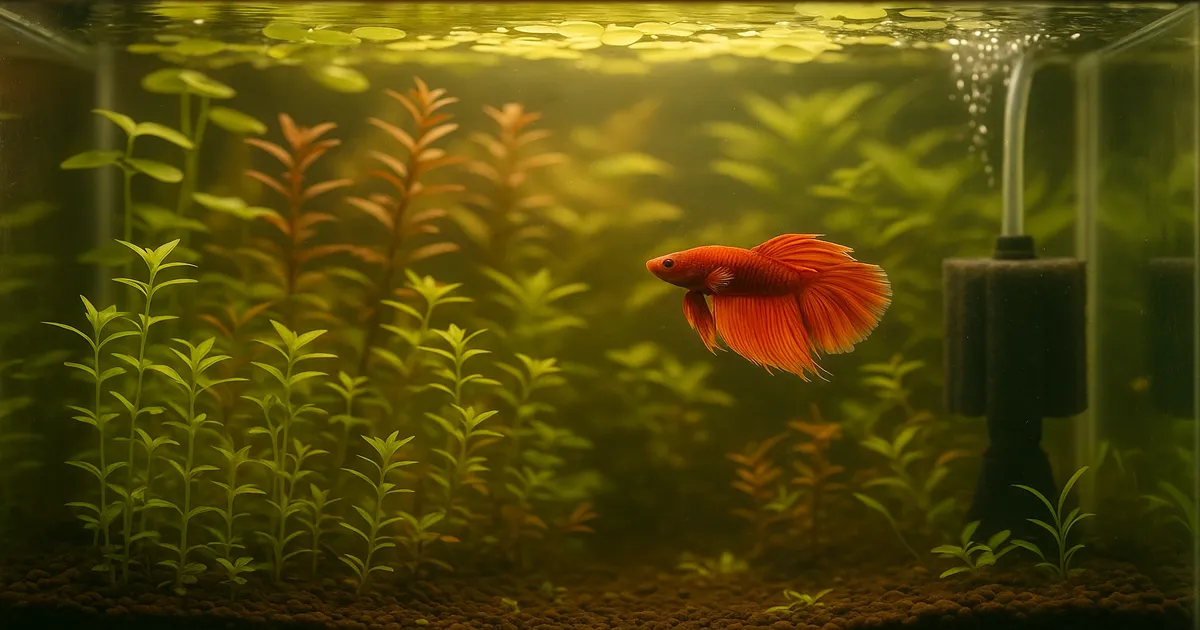
A sponge filter is the top choice for blind bettas. It produces gentle flow that won’t push the fish around, has no dangerous intake to blunder into, and its steady bubbling vibration may actually help the fish orient itself. If you’re using a hang-on-back filter, baffle the output heavily with a pre-filter sponge.
Target a gentle turnover of 3–5× tank volume per hour. The surface should be calm enough that the betta can reach it easily every time — bettas breathe atmospheric oxygen through their labyrinth organ, and strong surface turbulence is a real welfare issue.
Lighting
Keep lighting low to moderate and on a timer — 6–8 hours per day. Even partially blind bettas often retain some light sensitivity, and consistent day/night cycles support their circadian rhythm. Floating plants naturally diffuse overhead light and create shaded resting areas. Avoid sudden bright changes; if your room gets a lot of natural light variation, a timer is especially important.
How to Feed a Blind Betta Successfully
How Blind Bettas Find Food
A blind betta isn’t helpless at feeding time — it’s just using different senses. The lateral line detects tiny pressure waves in the water, smell draws the fish toward food from a distance, and movement (in live or frozen foods) triggers a hunting response. Your job is to put food close enough that these senses can do their work.
Best Foods
Daily staple:
- High-quality micro-pellets with insect meal or whole fish as the first ingredient (Hikari Betta Bio-Gold, Fluval Bug Bites Betta, and New Life Spectrum Betta all fit the bill)
2–3 times per week:
- Frozen bloodworms — strong scent, excellent for reluctant feeders
- Frozen daphnia — good for digestive health
- Frozen brine shrimp or mysis shrimp — nutrient-dense variety
- Live blackworms or mosquito larvae — movement triggers the lateral line beautifully; the best option for a betta that’s really struggling to find food
Feeding Technique
Use stainless steel feeding tongs or a pipette to place food directly in front of the fish’s mouth. Feed at the same spot every single time — blind bettas learn feeding locations quickly and will start hovering there at meal times once the routine is established.
Remove uneaten food after 2–3 minutes to protect water quality. Fast your betta one day per week to prevent constipation and obesity.
Foods to Avoid
- Freeze-dried foods as a staple — they expand in the stomach and cause bloating; soak thoroughly if you use them at all
- Flake food — poor nutritional value, sinks fast, and pollutes water before a blind betta can locate it
- Overfeeding — a betta’s stomach is roughly the size of its eye; 2–3 small pellets twice daily is plenty
Tank Mates for a Blind Betta
A blind betta cannot see a fin-nipper approaching or dodge a territorial display. For that reason, a species-only setup is the gold standard — one fish, one tank, no drama.
If you want some life in the tank beyond your betta, mystery snails (Pomacea bridgesii) and nerite snails are essentially risk-free. They clean algae, mind their own business, and most bettas ignore them completely.
Ghost shrimp and Amano shrimp can work, but success depends entirely on the individual betta’s temperament, and heavy plant cover is non-negotiable. Pygmy Corydoras (Corydoras pygmaeus) in groups of 6+ can coexist in a well-planted 15–20 gallon tank, but they add feeding complexity and disease risk. Quarantine any new addition for 4–6 weeks in a separate tank before introducing them to your blind betta.
Avoid completely:
- Any other male betta
- Fin-nippers: tiger barbs, serpae tetras, black skirt tetras
- Fast, boisterous fish that outcompete a blind betta for food (most danios, rainbowfish)
- Guppies and fancy mollies (trigger aggression)
- Aggressive cichlids of any kind
- Crayfish — they will attack a sleeping or disoriented betta without hesitation
Common Health Problems in Blind and Rescue Bettas
Quarantine First — No Exceptions
Every rescue betta goes into a quarantine tank for 4–6 weeks before anything else. Rescue fish are often immunocompromised and may carry parasites or infections that aren’t yet visible. A bare-bottom 5-gallon hospital tank with a sponge filter and heater is all you need. Treat what you find there, not in your display tank.
Popeye Disease
Caused by bacterial infection, almost always traced back to poor water quality or injury. The eye protrudes visibly; in severe cases it hemorrhages and ruptures. Treatment: improve water quality immediately, dose with kanamycin (Seachem Kanaplex) or minocycline (Maracyn 2), and consider Epsom salt baths (1 teaspoon per gallon) to reduce fluid retention. Even with successful treatment, the eye may not recover — but the fish often adapts well.
Cataracts
No cure exists. Once the lens clouds over, it stays that way. Management means exactly what this article describes: a stable tank, targeted feeding, gentle flow, and excellent nutrition to prevent further deterioration. A betta with cataracts can still live comfortably for years.
Fin Rot
Almost always a water quality problem first and a disease second. Fix the water, and mild cases often resolve on their own. For persistent bacterial fin rot, Kanaplex is effective. For fungal presentations (white, cottony edges), API Fungus Cure works well. Avoid Melafix at full dose — it can damage the labyrinth organ.
Velvet (Oodinium)
Velvet looks like a fine gold or rust-colored dust on the body and fins — you often need a flashlight held at an angle to spot it. Affected fish breathe rapidly, scratch against surfaces, and become lethargic. Treatment: copper-based medication (Seachem Cupramine), lights completely off (the parasite is photosynthetic), and a temperature raise to 82°F (28°C). Remove carbon from the filter before treating.
One more warning sign: if your betta’s scales are sticking outward like a pinecone and the belly is bloated, that’s dropsy — a sign of severe internal organ failure, often bacterial. It’s very difficult to treat successfully, but catching it early with Kanaplex gives the best odds. Pristine water quality is the best prevention.
Frequently Asked Questions: Rescuing a Blind Betta
Can a blind betta fish live a normal life?
Yes. Blind bettas can eat, explore, rest, and thrive — they simply rely on smell, lateral line vibration, and residual light perception instead of vision. With a stable tank layout, targeted feeding, and good water quality, quality of life can be excellent. Lifespan depends far more on overall health and prior neglect than on blindness itself.
How do I know if my betta is blind?
Look for cloudy or opaque eyes (cataracts), missing or damaged eyes, or a betta that consistently fails to react to food dropped in from above. A blind or partially blind betta may also bump into decorations, swim erratically, or hover in one spot more than usual. Behavioral signs are usually clear, but a vet can confirm the diagnosis.
How do you feed a betta that can’t see?
Use stainless steel tongs or a pipette to place food directly in front of the fish’s mouth, at the same spot in the tank every feeding. Frozen bloodworms and live foods work especially well because their scent and movement trigger the betta’s lateral line. Always remove uneaten food within 2–3 minutes.
Can betta blindness be reversed?
It depends on the cause. Cataracts are permanent — no treatment exists. Blindness from Popeye can sometimes be partially reversed if caught very early and treated aggressively with antibiotics, but a ruptured eye will not regrow. Blindness from velvet or bacterial infection may partially improve once the underlying condition is treated, though scarring is often permanent.
Should a blind betta be kept alone?
A species-only setup is the safest choice. Blind bettas can’t see threats approaching, making them vulnerable to fin-nipping and harassment. If you want tank companions, mystery snails or nerite snails are essentially risk-free. Shrimp and small bottom dwellers like pygmy Corydoras can work in larger, heavily planted tanks — but always quarantine new additions for 4–6 weeks first.