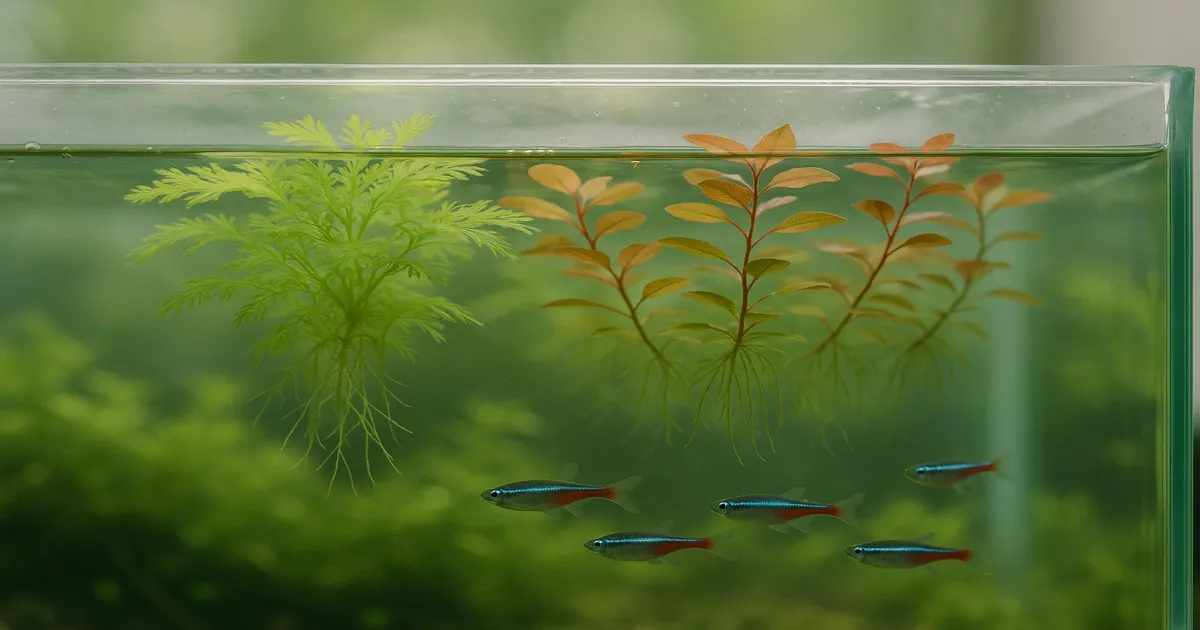
Quick Answer: Yes, you can keep floating plants in a lidded tank — but a standard glass or acrylic lid will actively work against them. Light loss, CO₂ depletion, and condensation drip are the three main culprits. Switching to a mesh lid, or modifying your existing lid to include open sections, solves most of these problems without sacrificing fish safety.
Floating plants in a lidded tank is one of those topics where the answer depends entirely on which lid you’re using. The glass hood that came with your aquarium? That’s going to cause problems. A mesh lid or a modified setup with open sections? Totally workable — and the plants will thrive. This guide walks through exactly why standard lids cause issues and what you can do about it.
Why Standard Lids Harm Floating Plants
Light Loss Through Glass and Acrylic
Clear glass absorbs roughly 8–10% of PAR (photosynthetically active radiation) before light even reaches your plants. Frosted or tinted acrylic does far more damage — 20–40% loss is common. Add condensation on the underside of the lid and you can lose another 10–30%. A demanding species like Red Root Floater (Phyllanthus fluitans), which needs 80–150+ PAR at leaf level, could be receiving less than half of what your fixture actually produces. Even a clean, clear glass lid is a meaningful handicap.
CO₂ Depletion and Stagnant Air
A sealed lid traps a thin air pocket between the glass and the water surface. Floating plants photosynthesize through stomata on their upper leaves — they pull CO₂ directly from that air pocket. In a sealed system, that gas depletes quickly and gets replaced with oxygen and water vapor. The plants essentially suffocate themselves. Unlike submerged plants that can absorb dissolved CO₂ from the water column, floating plants depend entirely on atmospheric gas exchange. Cut that off and growth stalls, then reverses.
Condensation Drip and Crown Rot
Humidity inside a sealed tank rapidly approaches 100%, and that moisture condenses on the underside of the lid and drips back down. For Dwarf Water Lettuce (Pistia stratiotes) and Red Root Floater, this is genuinely dangerous. Both have hydrophobic rosette leaves designed to shed water — but constant dripping overwhelms that mechanism, causing water to pool in the crown and triggering rot. A single week under a dripping lid can destroy an otherwise healthy mat of Pistia.
Insufficient Headspace
Standard lids sit roughly 0–0.5 inches above the waterline. Floating plants with emergent growth — Pistia, Amazon Frogbit (Limnobium laevigatum), Water Hyacinth — need 3–6 inches of air space to develop properly. Even low-profile species like Salvinia benefit from at least 1–2 inches of clearance. A glass lid pressing down on a mat of frogbit physically deforms the plants and prevents normal growth.
Can You Keep Floating Plants in a Lidded Tank? Five Practical Solutions
Option 1: Switch to a Mesh or Screen Lid (Best Overall)
Replacing your glass panels with aluminum window screen or stainless steel mesh solves all three core problems at once — light passes through freely, gas exchange is unrestricted, and condensation drip essentially disappears. Look for a mesh size of 1/16” to 1/8” (1.5–3 mm), which stops most jumping fish while allowing good airflow.
Commercial options include lids from Lifeguard Aquatics and Aquatic Life. DIY versions are easy to build with aluminum frame stock and window screen from any hardware store. Use aluminum or stainless steel only — galvanized mesh can leach zinc into the water.
Pros: Solves light, CO₂, and condensation issues; still prevents jumping; allows natural humidity regulation. Cons: Increases evaporation; fine debris can fall through.
Option 2: Modified Glass Lid with Open Cutout Sections
Remove one or more panels from your existing lid and leave designated open sections over your floating plant zone. Keep glass panels over equipment — heater, filter return — to limit evaporation from those areas. Floating plants will naturally colonize the open section.
Pros: Reduces evaporation over equipment; easy to implement with existing lids. Cons: Some jumping risk in the open area; gas exchange still restricted over covered sections.
Option 3: Raised Lid Using Egg Crate
Egg crate (plastic light diffuser panels from hardware stores) makes excellent lid risers. Cut them to size and use them to elevate your existing lid 3–4 inches above the waterline. The grid pattern allows significant light and airflow through, creating a ventilated microclimate with proper headspace.
Pros: Creates genuine headspace; improves gas exchange; inexpensive. Cons: Doesn’t fully eliminate condensation; some fish may escape through the gaps.
Option 4: Dedicated Open-Top Section at One End
Design your aquascape so floating plants occupy one end of the tank and leave that end lidless. A splash guard or simple acrylic baffle can protect the open section from filter turbulence. Place jumping-prone fish in the covered section.
Pros: Best of both worlds for mixed stocking; no compromise on plant conditions. Cons: Requires planning; open section still poses jumping risk if fish roam freely.
Option 5: Full Open-Top Setup
No lid at all is genuinely ideal for floating plants. The trade-off is evaporation — an open 55-gallon tank can lose an inch of water per week or more depending on ambient humidity. An auto top-off (ATO) system handles this automatically and keeps water level consistent. The Tunze Osmolator Universal 3155 is a reliable choice for tanks up to 100 gallons. Stick with non-jumping species and this is the easiest long-term solution.
Pros: Optimal conditions for all floating plant species; zero light or gas exchange compromise. Cons: Evaporation; limits stocking options; requires ATO or daily top-offs.
Water Parameters, Lighting, and Flow
Temperature, pH, and Hardness
Most tropical floating plants do best at 72–82°F (22–28°C). Cold-tolerant species like Lemna minor and Hornwort can handle down to 60–65°F (15–18°C), but they won’t thrive in a tropical community setup.
For pH, slightly acidic to neutral water (6.5–7.5) suits the majority of species. Pistia stratiotes is the exception — it actually prefers slightly alkaline conditions (pH 7.0–8.0). Red Root Floater shows its best red coloration in soft, acidic water (pH 6.0–7.0). Salvinia is the easy-going one, tolerating pH 6.0–8.0 without complaint.
Target a general hardness of GH 3–12 dGH and carbonate hardness of KH 2–8 dKH. Hard water above GH 15 dGH can leave mineral deposits on leaves that further reduce light absorption — a real problem in a lidded tank where you’re already losing PAR. A reliable liquid test kit like the API Freshwater Master Test Kit makes it easy to stay on top of these parameters.
Floating Plants as Natural Filters
This is one of the most underappreciated things about floating plants: they’re exceptional biological filters. They absorb ammonia and nitrate directly through their roots, often outperforming conventional filter media in densely planted setups. They thrive in elevated nitrate (10–40 ppm) and will actively pull it down. Phosphate uptake is similarly impressive at 0.1–1.0 ppm. This makes them a genuine asset in shrimp tanks, fry tanks, and any setup where water quality stability matters.
Lighting: PAR Targets by Species
- Low-light (20–40 PAR): Salvinia, duckweed, Riccia — most forgiving of light loss through glass
- Medium-light (40–80 PAR): Amazon Frogbit, Hornwort — workable with a clear glass lid and a strong LED
- High-light (80–150+ PAR): Dwarf Water Lettuce, Red Root Floater, Water Hyacinth — mesh or open-top strongly recommended
Use a high-output LED positioned as close to the lid as practical. The Fluval Plant 3.0 is a solid all-around choice; the Chihiros WRGB II performs well for high-light species. If you’re running a glass lid, wipe condensation from the underside daily — it makes a measurable difference in light transmission. Run a photoperiod of 10–14 hours. Going beyond 16 hours doesn’t accelerate growth and can trigger stress responses.
Flow Rate
Floating plants evolved in still and slow-moving water. Strong surface agitation breaks up mats, damages delicate roots, and pushes plants into corners. A gentle ripple is fine — breaking waves are not. Sponge filters are ideal. For canister filters, angle the spray bar downward or use a submerged return. HOB filters can work if you baffle the output with a small piece of filter sponge to reduce surface turbulence.
Best Species for Lidded Tanks
Common Floating Plant Species
| Common Name | Scientific Name | Light Need | Lid Compatibility |
|---|---|---|---|
| Salvinia | Salvinia minima | Low | Excellent |
| Duckweed | Lemna minor | Low | Excellent |
| Riccia | Riccia fluitans | Low | Good |
| Amazon Frogbit | Limnobium laevigatum | Medium | Good (clear lid + strong LED) |
| Hornwort | Ceratophyllum demersum | Medium | Good |
| Dwarf Water Lettuce | Pistia stratiotes | High | Mesh or open-top only |
| Red Root Floater | Phyllanthus fluitans | High | Mesh or open-top only |
| Water Hyacinth | Eichhornia crassipes | High | Open-top only |
| Mosquito Fern | Azolla caroliniana | Low–Medium | Good |
Invasive species note: Pistia, Eichhornia, and Azolla are considered invasive in many regions. Never release them into local waterways.
Salvinia minima is probably the most forgiving floating plant you can keep under a lid. Its tiny, fuzzy leaves sit low on the water surface, it needs only 20–40 PAR, and it grows quickly even in suboptimal conditions. Duckweed is similarly bulletproof — almost comically easy to grow, though its rapid spread requires regular thinning.
Amazon Frogbit is a beautiful, fast-growing plant with round leaves and long trailing roots that fish love. It does fine under a clear glass lid with a quality LED — just keep that glass clean. Dwarf Water Lettuce and Red Root Floater are stunning but demanding. If you want to keep these under a lid, mesh isn’t optional — it’s necessary.
Compatible Fish and Tank Mates
Bettas are perhaps the perfect floating plant companion. They love the cover, build bubble nests under frogbit leaves, and prefer the still water floating plants need. Just make sure there are gaps in the plant coverage — bettas are labyrinth fish that need to breathe air at the surface. Gouramis have the same air-breathing requirement and the same appreciation for surface cover.
Corydoras and Otocinclus are excellent bottom-dwellers completely unaffected by surface plants. Small rasboras — Boraras and Trigonostigma species — are peaceful, don’t disturb the surface, and look stunning swimming beneath a green canopy. Neocaridina and Caridina shrimp are ideal tank mates: they graze biofilm from plant roots, benefit from the improved water quality, and are too light to disturb the surface.
Fish to avoid: Goldfish and koi will eat virtually all floating plants. Silver Dollars (Metynnis spp.) and Buenos Aires Tetras are voracious herbivores that will strip a tank clean. Oscars and large cichlids will physically disrupt and damage surface plants through their activity alone.
One more thing worth knowing: dense floating plant mats can be allelopathic — they release compounds that inhibit the growth of submerged plants. Keep surface coverage to 50–70% maximum in a planted tank to maintain balance.
The Jumping Fish Dilemma
This is the central tension of the whole topic. Hatchetfish, danios, killifish, and many tetras are notorious jumpers that genuinely require a lid — but those same lids harm your floating plants. A mesh lid is the cleanest solution: it contains jumping fish while preserving the gas exchange and light transmission that floating plants need.
Tank Setup and Filtration
A 20-gallon minimum gives you enough surface area to manage coverage actively. In smaller tanks, floating plants will cover the entire surface within weeks, blocking light to submerged plants and reducing oxygen exchange for fish.
Sponge filters are the gold standard for floating plant tanks — gentle, effective, and they produce zero surface disturbance. The Hikari Bacto-Surge works beautifully in tanks up to 40 gallons. For larger setups, canister filters with the spray bar angled downward keep flow gentle.
Since floating plants don’t root into substrate, your substrate choice matters primarily for water chemistry. Inert gravel or sand has a neutral effect but requires liquid fertilizer supplementation. Nutrient-rich substrates like ADA Aqua Soil Amazonia leach nutrients that floating plant roots can absorb and will also lower pH — good for Red Root Floater, less ideal for Pistia. Avoid crushed coral or aragonite if you’re keeping acid-preferring species; it raises pH and KH in ways that work against them.
FAQ: Floating Plants in a Lidded Tank
Can you keep floating plants in a lidded tank without any modifications? It depends on the species. Low-light plants like Salvinia and duckweed can survive under a clean, clear glass lid with a strong LED. High-light species like Dwarf Water Lettuce and Red Root Floater will decline without modification. For best results across all species, switch to a mesh lid or add open sections.
Will a glass lid cause my floating plants to die? Not immediately, but it will slow growth and can cause crown rot in sensitive species like Pistia and Red Root Floater. The combination of light loss, CO₂ depletion, and condensation drip creates conditions that floating plants are not adapted to handle.
How much headspace do floating plants need above the waterline? Low-profile species like Salvinia and duckweed need at least 1–2 inches. Emergent species like Amazon Frogbit, Dwarf Water Lettuce, and Water Hyacinth need 3–6 inches to develop properly. A standard glass lid sitting flush with the waterline provides essentially none of this.
Do floating plants need CO₂ injection? No. Floating plants draw CO₂ directly from the air above the water surface — they don’t use dissolved CO₂ the way submerged plants do. This is actually one of their advantages: they grow fast without any CO₂ supplementation, as long as the air above them is not sealed off by a lid.
What is the easiest floating plant to keep in a lidded tank? Salvinia minima is the most forgiving option. It tolerates low light, adapts to a range of water parameters, and grows quickly even in suboptimal conditions. Duckweed (Lemna minor) is equally easy but spreads aggressively and can be difficult to control once established.