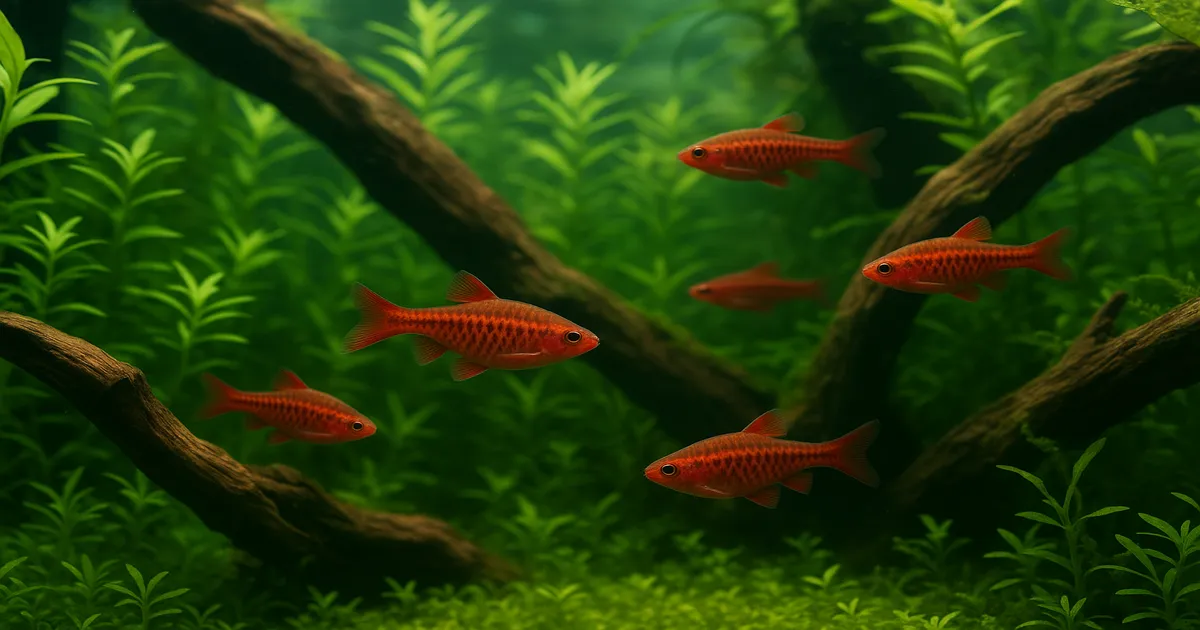
Quick Answer: Cherry barbs are peaceful, beginner-friendly fish that thrive in groups of 6 or more in a 20-gallon planted tank. Keep water slightly acidic (pH 6.5–7.0) at 73–79°F (23–26°C), feed a varied omnivorous diet, and these hardy little fish will reward you with years of vibrant color and active behavior.
Cherry barbs (Puntius titteya) are one of the best community fish you can buy — and knowing how to care for cherry barbs properly makes the difference between dull, stressed fish and the vivid crimson display males are famous for. Native to the shaded forest streams of Sri Lanka, they’re hardy, peaceful, and forgiving of beginner mistakes, as long as you get the basics right from the start.
Cherry Barb Care at a Glance
| Stat | Details |
|---|---|
| Adult Size | 1.5–2 inches (3.8–5 cm) |
| Lifespan | 4–6 years |
| Difficulty | Beginner-friendly |
| Minimum Tank Size | 20 gallons |
| Group Size | 6+ (ideally 8–12) |
| Temperature | 73–79°F (23–26°C) |
| pH | 6.5–7.0 |
| GH | 4–10 dGH |
| Diet | Omnivore |
| Temperament | Peaceful |
Essential requirements at a glance:
- Fully cycled tank — ammonia and nitrite must read 0 ppm before fish go in
- Groups of 6 minimum, with a 1:2–3 male-to-female ratio
- Planted tank with floating plants to diffuse overhead light
- Gentle filtration — these fish come from slow-moving streams
- 25–30% weekly water changes to keep nitrates low
- Varied diet of quality pellets plus frozen or live foods several times a week
Nearly every cherry barb sold today is captive-bred, which means they’re already adapted to a wider range of conditions than their wild ancestors. That said, mimicking their natural habitat will bring out their best coloration and behavior.
Species Background
Natural Habitat and Origin
Cherry barbs are endemic to Sri Lanka, specifically the Kelani and Nilwala river basins in the island’s southwestern wet zone. Their natural home is shaded, slow-moving forest streams with tannin-stained water, leaf litter substrates, and dense vegetation overhead. Think dark, soft, slightly acidic water — the opposite of a bright, bare aquarium.
The species is currently listed as Vulnerable on the IUCN Red List, primarily due to habitat destruction and historical over-collection for the aquarium trade. Virtually all cherry barbs sold today are captive-bred, which has significantly reduced pressure on wild populations. Captive-bred fish are also more adaptable — they tolerate a wider pH and hardness range than wild-caught specimens.
Cherry Barb Variants: Albino and Long-Fin
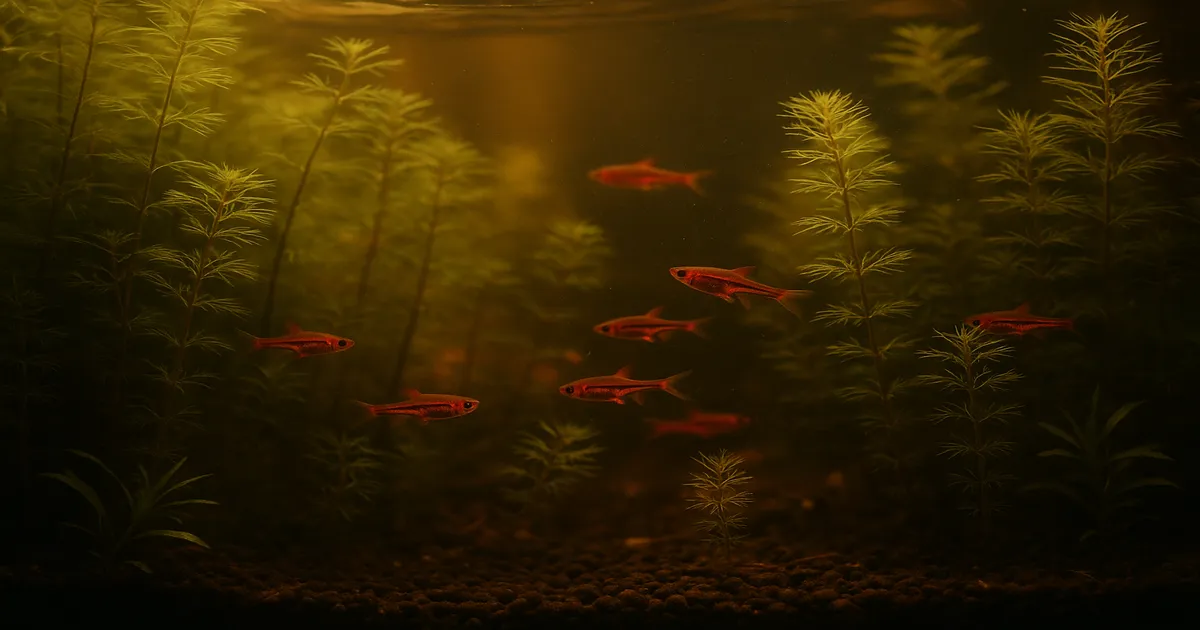
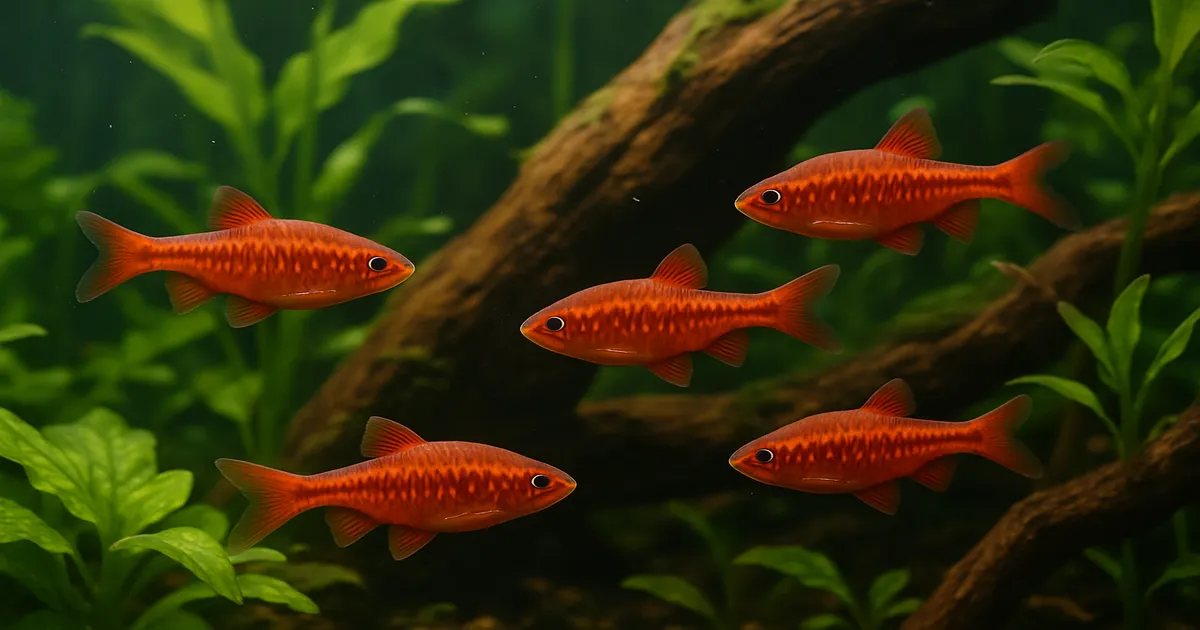
Beyond the standard wild type — brilliant red males, golden-brown females with a dark lateral stripe — two popular variants are worth knowing:
- Albino cherry barb — cream-white body with pink-red coloration; slightly more light-sensitive than the standard form
- Long-fin cherry barb — flowing, extended fins; beautiful but requires tank mates that won’t nip
Sexual dimorphism is pronounced and becomes obvious around 3–4 months of age, when males develop their signature red coloration.
Ideal Water Parameters for Cherry Barbs
pH, Hardness, and Temperature
| Parameter | Ideal | Acceptable |
|---|---|---|
| pH | 6.5–7.0 | 6.0–7.5 |
| GH | 4–10 dGH | 2–15 dGH |
| KH | 3–6 dKH | 2–10 dKH |
| Temperature | 73–79°F (23–26°C) | 70–82°F (21–28°C) |
Sustained pH above 7.8 causes stress and color fading. Very hard water (above 15 dGH) isn’t recommended long-term and can impair breeding. Stability matters as much as the numbers themselves — a sudden swing in temperature or pH is more damaging than water that sits slightly outside the ideal range.
Target ammonia and nitrite at 0 ppm always, and keep nitrates under 20 ppm with a hard ceiling of 30 ppm. Cherry barbs are moderately sensitive to nitrogen compounds, so never add them to an uncycled tank. Test your water regularly with a reliable liquid test kit before and after introducing fish.
Tannins and Blackwater Conditions
Adding Indian almond leaves, driftwood, or alder cones creates mild tannin staining that mimics the cherry barb’s natural habitat. Beyond aesthetics, tannins have mild antibacterial properties, help lower and buffer pH naturally, and visibly deepen the red coloration of males. You don’t need to go full blackwater — even a few leaves scattered on the substrate make a meaningful difference.
Water Change Schedule
Aim for 25–30% weekly water changes. This keeps nitrates in check without disrupting the tank’s beneficial bacteria. Always treat tap water with a dechlorinator before adding it to the tank — a concentrated formula like Seachem Prime is cost-effective and detoxifies ammonia and nitrite in emergencies too.
How to Care for Cherry Barbs: Tank Setup
Tank Size and Dimensions
A 20-gallon tank is the workable minimum for a group of 6. For a colony of 8–12 fish — where cherry barbs really shine — a 29–30 gallon is a much better choice. Prioritize a longer footprint over height. These are active mid-water swimmers that need horizontal space, not depth.
Substrate and Décor
Fine dark sand is the ideal substrate — it reflects less light, shows off the fish’s colors beautifully, and closely mimics their natural environment. A dark-toned aquarium sand works well. Layer a handful of dried Indian almond or oak leaves on top for a naturalistic look that also provides shelter and releases tannins slowly over time.
Plants and Aquascaping
A well-planted tank isn’t optional for cherry barbs — it’s essential for their confidence and color. Think in zones:
- Background: Vallisneria, Hygrophila, Ludwigia, Rotala
- Midground: Java fern, Anubias (both easy and low-light tolerant)
- Floating: Water sprite, frogbit — critical for diffusing light and reducing surface brightness
Floating plants are the single most impactful addition you can make. They naturally dim the light reaching the fish, reduce stress, and almost immediately bring out deeper red coloration in males. Leave some open mid-water areas for swimming; cherry barbs like cover but still need room to move.
Filtration and Flow
Cherry barbs come from slow-moving streams, so strong current is a problem. A hang-on-back (HOB) or canister filter running at 4–6× tank volume per hour is ideal — just baffle the output or direct it along the back wall to prevent blasting the fish. Fit a sponge pre-filter to the intake to protect small fish and any future fry.
Lighting
Low to moderate lighting suits cherry barbs best. Run your LED fixture for 8–10 hours per day on a timer. If your light is bright, floating plants will do most of the work softening it. Dark substrate plus subdued lighting is the formula for maximally vibrant male coloration — one of the most reliable tricks in the hobby.
Tank Mates and Compatibility
Cherry barbs are genuinely peaceful — one of the few barb species with essentially no fin-nipping tendency. Males will spar and display to each other in a showy but harmless way, especially when females are nearby. Keep at least 6 fish together and aim for a ratio of 1 male to every 2–3 females to prevent any individual female from being over-pursued.
Good tank mates:
- Harlequin rasboras, ember tetras, neon and cardinal tetras
- Corydoras catfish (any species — ideal bottom companions)
- Otocinclus catfish and kuhli loaches
- Honey gouramis and Endler’s livebearers
- Bristlenose plecos
Shrimp compatibility: Adult Amano shrimp are generally safe. Small or juvenile cherry shrimp (Neocaridina davidi) are at risk — cherry barbs are opportunistic feeders and will eat anything that fits in their mouth. Dense planting improves shrimp survival odds considerably.
Fish to avoid:
- Tiger barbs — aggressive fin-nippers
- Male bettas — territorial and likely to attack
- Large cichlids (Oscars, Jack Dempseys) — will simply eat them
- Serpae and Buenos Aires tetras — known fin-nippers
- Goldfish — incompatible temperature needs and size difference
Feeding Cherry Barbs
In their native streams, cherry barbs eat aquatic insect larvae, zooplankton, small crustaceans, algae, biofilm, and organic detritus. They’re true omnivores, which makes feeding them in captivity straightforward.
Daily staples:
- High-quality micro pellets
- Tropical flake food
- Spirulina flakes for plant matter and color support
2–4 times per week:
- Frozen bloodworms, daphnia, brine shrimp, or mysis shrimp — these make a visible difference in coloration and breeding condition
- Live foods (daphnia, brine shrimp, microworms) are especially valuable when conditioning fish for breeding
Blanched zucchini or spinach can be offered occasionally. Freeze-dried foods are convenient but lower in nutritional value than frozen — use them sparingly.
Feeding schedule:
- Adults: twice daily, offering only what fish consume in 2–3 minutes
- Juveniles: three times daily in small amounts
- One fasting day per week — good for digestion and prevents obesity
Cherry barbs are mid-water feeders and can be timid around boisterous tank mates. If they’re hanging back while faster fish grab everything, try feeding in two spots simultaneously or use a pipette to target-feed shyer individuals. Sinking pellets also help fish that won’t compete at the surface.
Common Diseases and How to Prevent Them
Ich (White Spot Disease)
Look for white, salt-grain-sized spots on the body and fins, along with flashing behavior and rapid gill movement. Treatment: gradually raise temperature to 82–84°F (28–29°C) to accelerate the parasite’s life cycle, then treat the entire tank with an ich-specific medication (Ich-X) following the full dosing schedule for at least two weeks.
Velvet Disease
Velvet is trickier to catch. Shine a flashlight at a low angle across your fish — infected individuals will show a fine gold or rust-colored dust on their skin, along with clamped fins and rapid breathing. Turn off tank lights immediately (the Oodinium parasite is photosynthetic), then treat with a copper-based medication such as Seachem Cupramine and raise temperature slightly to speed the parasite’s life cycle.
Prevention
The vast majority of disease outbreaks trace back to three causes: poor water quality, temperature swings, and skipping quarantine. Quarantine all new fish for 4–6 weeks in a separate tank before introducing them to your display. Stable parameters and regular water changes are your best preventative medicine.
Signs of a healthy cherry barb: vibrant, saturated coloration; active, confident swimming; a strong appetite; no clamped fins, visible spots, or lesions.
Frequently Asked Questions About Cherry Barb Care
How many cherry barbs should be kept together?
Keep a minimum of 6 — they’re a shoaling species and become stressed, shy, and less colorful in small numbers. A group of 8–12 is even better. Aim for a ratio of 1 male to 2–3 females to prevent males from harassing individual females.
Are cherry barbs suitable for beginners?
Yes. They’re hardy, peaceful, unfussy eaters, and tolerant of a range of water conditions. The main requirements — a cycled tank, planted setup, and a proper group size — are fundamentals any new fishkeeper should master anyway, making cherry barbs an ideal starting point.
What is the minimum tank size for cherry barbs?
A 20-gallon tank is the minimum for a group of 6. For a larger colony of 8–12 fish, a 29–30 gallon gives them the swimming space they need. Always prioritize a longer tank over a taller one.
Can cherry barbs live with betta fish?
Generally not recommended. Male bettas are territorial and may attack cherry barbs, especially males displaying vibrant red coloration that could be perceived as a rival. A female betta in a large, heavily planted tank might coexist peacefully, but there are many safer tank mate options.
How can I make my male cherry barb more red?
Several factors work together: subdued lighting, a dark substrate, floating plants to diffuse overhead light, and a diet that includes frozen or live protein foods like bloodworms and brine shrimp several times a week. Keeping nitrates low prevents the color fading that comes with chronic stress, and adding Indian almond leaves for tannins deepens the effect further.